PDF (27 pp.) · Word (.docx) · The Mirror Calculus · Deprogramming Zero
Abstract
Formation precedes assertion. This paper defends presence-only formation as the accurate grammar of mathematical presentation: an object-language expression may form only when sponsored by a positive witness, trace, relation, transformation, roster, pairing, or certificate, and every term has a sponsor, and a sponsor is a presentation. Numerical zero is the formed sign for a non-presentation; [empty collections, null returns, default falsity] and their relatives are its surrogates, the same office under other spellings, and all are analyzed as reifications of non-presentation. Transcendental Presence Notation (TPN) implements the principle: only positively sponsored inscriptions form. The Descent Calculus builds mathematics from the plenum downward, precipitating positive residues with genealogical numerals under a Sweeping Law. The Mirror Calculus supplies the strict syntax: reflection-equivariant, machine-checked, with a kernel-certified core fragment. In the resulting presence grammar the conventional zero-locus sentence of the Riemann hypothesis is held outside formation — it converts a withheld presence-valued evaluation into [equality with a numerical object] — while the native axis question is well formed and receives a five-register resolution, register-typed and priced rather than an unconditional classical proof: derivation in the adopted theory \(P^{\dagger}\), sponsored omega-completion under a registered seal rule, relative independence of class-wide Admission from the base calculus, and a classical interface that identifies the exact price of transfer, \(I\left( {Adm}_{\zeta} \right) \Leftrightarrow {RH}_{C}\). The same formation discipline bears directly on intelligent decision systems: every judgment names its sponsor — a completion certificate, an exclusion, a rejection, or a coverage record — and the promotion of a withheld presentation to [negative assertion] is, in engineering form, exactly the reification this paper analyzes in mathematics.
Keywords: presence-only formation; zero; withheld data; formal grammar; Lean; Riemann hypothesis; independence; decision systems. The object language is the protagonist throughout; every classical appearance in the paper is an interpretation the interface prices.
© 2026 Parker M. D. Emmerson. All rights reserved. This summary, the programme texts it summarizes (The Mirror Calculus, Against Zero, Counting Back from Infinity, Deprogramming Zero), and their notation, plates, and source are the copyright of the author; reproduction or adaptation in any form requires written permission. Quotation for scholarly review with attribution is welcome.
What is new here. Four things, separable from what is imported. A reflection-equivariant presence-only grammar with a closed atom inventory, twelve constructors, and a kernel-certified fragment — a formal language whose every object-level term stands for a presentation, carried far enough to state and check real mathematics. The consequence for the Riemann question: conditional on presence-only formation being the accurate grammar of mathematical presentation, the conventional zero-locus sentence is held outside formation, since it converts a withheld presence-valued evaluation into equality with a numerical object, while the native axis sentence is well formed and its classical price is stated exactly; the force of that result scales with its antecedent, which is argued separately. The register discipline itself: an assertion-record schema under which every consequential claim names its sponsor, its stratum, and the interface priced for any transfer, applied to a hard subject in full. And the surrogate-zero taxonomy with its engineering transfers, which a fully classical reader may adopt entire.
What sponsors what. Each result here is read off its sponsor. P† ⊢ RHₘ is a derivation. The relative independence of class-wide Admission from the base is a theorem with both sides exhibited by finite models. The interface equivalence I(Admζ) ⇔ RHᴄ is proved from the definition of the interface, in the classical metatheory — standing outside a language is the condition of speaking about it, so the register separation is the instrument of reach rather than a limit on it. Admζ itself is present in P† by declaration, sponsored by αζ, at a fork the independence theorem proves inhabited on both sides; under the interface RHᴄ accordingly holds, and the verdict carries that sponsor on its face. A verdict forms with a presented sponsor; the sponsor is constitutive of the object. The residue is named and located: faithful reference to the completed prime-fused descent.
Formation and the argument against zero
Thesis. Formation precedes assertion. This paper defends presence-only formation as the accurate grammar of mathematical presentation. An object-language expression may form only when sponsored by a positive witness, trace, relation, transformation, roster, pairing, or certificate. Every term has a sponsor, and a sponsor is a presentation. Numerical zero is the formed sign for a non-presentation, and [empty collections, null returns, default falsity] and related devices are its surrogates — the same office under other spellings — so all are analyzed as reifications of non-presentation.
Two claims must be distinguished at once, because conflating them would beg the question the paper takes seriously. The first is foundational: that presence-only formation is the accurate account of how mathematical content is actually presented — counting requires prior presentation and individuation; one is imposed unity under a procedure; a definition licenses a formal regime, and an ontology asks for proof of its own. That claim is defended by transcendental argument, in the source treatise Against Zero and its successor Counting Back from Infinity, and this paper summarizes the argument. The second is formal: that the grammar which results when the principle is enacted is exhausted by its own sentence-forms, the specified classical forms held outside it. That claim is a theorem about a defined syntax. The grammar's foundational accuracy is a claim beyond the grammar itself; the transcendental argument defends why the grammar should govern, and the theorems then say what governs within it.
The position has a lineage and a distinctness worth fixing. Constructive mathematics in the Bishop line [1] demands witnesses for existence claims, and type theory in the Martin-Löf line [2] makes inhabitation the meaning of a proposition; presence-only formation is downstream of both in spirit but orthogonal in axis. The constructive tradition’s target is the law of excluded middle and nonconstructive existence; it retains [the empty type, the zero, and the vacuous universal] as perfectly formed citizens. The presence critique targets reification: its subject is which sentences form at all, prior to which inferences are licensed over formed sentences, and its casualties are exactly the citizens constructivism retains. One can be a classical logician about formed sentences and a presence theorist about formation; the two disciplines compose. Similarly, the database literature’s open-world assumption and the knowledge-representation distinction between “recorded false” and “not recorded” are engineering anticipations of the same insight, and the foundational generalization is this program's supply.
The critique proceeds from the observation that classical practice maintains [a family of devices] whose shared function is to convert a withheld presentation into a positively inscribed object: the numeral zero [a count reported ahead of any individuated member], [the empty collection (a roster “with no members”), the null return (a value standing in for a withheld value), default falsity and vacuous truth (verdicts issued over unoccupied domains), and the negative record inferred from a search that “returned no record”]. The numeral zero is the sign itself; each of the others is a surrogate zero: a sign whose semantic job is to make non-presentation behave as a first-class citizen of the theory. The founding analysis names the general move reification of non-presentation and observes that replacing the numeral by a synonym — [absence, null, none, empty] — changes the costume and keeps the category. Table 1 collects the family with the presence-only replacement discipline.
The sign, its surrogates, and their replacements.
| the sign and its surrogates | presence-only discipline |
|---|---|
| numeral zero | counting begins at one; a tally exists only over a nonempty roster |
| [empty collection] | a roster forms from presented members, one at least |
| [null return] | withheld emission is a metalanguage judgment; the object language returns presented values |
| default falsity | a contrary requires its own positive witness |
| vacuous truth | a verdict forms over an occupied domain, with its witnesses |
| [negative record from a failed search] | exclusion is its own record, formed by a positive coverage event |
The transcendental argument behind the table runs, in compressed form, as follows. Counting is an act performed on presented individuals: before a tally can begin, something must be given, and given as countable — individuated under a procedure that says where one individual ends and the next begins. “One” is therefore an imposed unity rather than a primitive found in nature: the first act of a counting procedure. It follows that the numeral sequence records a history of acts, and that a member of the sequence defined by [an act that found no individuals] is a member of another kind: the procedure’s withheld outcome dressed as the procedure’s output. The argument grants the classical regime its formal consistency and its spectacular usefulness in full; a definition licenses a formal regime. A definition licenses; an ontology asks for its own proof, and the foundational claim is exactly at that joint: the zero-based regime is a licensed formalism whose central device misdescribes the phenomenon of presentation it is supposed to systematize.
The misdescription propagates. [Closed-world] and [negation-as-failure] systems infer \(\neg P\) upon the closing of the derivation of \(P\) [3]; presence-only formation permits that inference exactly when a positive completeness or coverage certificate closes the relevant search domain — short of the certificate, the inference promotes an unperformed verification into a performed refutation, which is default falsity in this paper’s sense. [Vacuous truth] issues “all \(F\)s are \(G\)” as a verdict over a domain whose every member is yet to present — a universal judgment with the witness's place standing open. The search that closes and is read as [“negative record”] commits the same conversion in epistemic form: the search’s coverage is the fact, and only a positive coverage event — this procedure examined these sources over this range and completed — can sponsor an exclusion. In each case the classical device stands as bookkeeping; it is wrong as semantics, because it installs an object where the ledger holds a withheld act.
The positive obligations are symmetric: positive contraries require independent witnesses. A rejection is its own inscribed act, with its own sponsor. The critique admits two clarifications that prevent misreadings. First, renaming leaves it in place: a language that bans the numeral [“0”] and retains an object called [null, none, empty set, or absence] with the same inferential role has changed the costume and kept the category; the analysis targets the role — any object-language sign whose semantic job is to make non-presentation participate in operations — and the replacement discipline is structural before it is lexical. Second, it stands with mathematics: the positive fragment of classical constructions transfers where an interpretation theorem has been supplied and all quantified objects and operations are presented, and Section 6 exhibits standard invariant theory, residue counting, and spectral geometry running under exactly such interpretations. What changes is the treatment of the boundary cases — [the empty roster, the null return, the vacuous domain] — which are precisely where classical formalism and presentational fact come apart, and precisely where deployed decision systems fail today (Section 7). The discipline is demanding, and the remainder of the paper shows that it is workable at full mathematical scale — through a formal notation (Section 2), a foundational calculus built from the top down (Section 3), a strict machine-checked syntax (Section 4), classical realizations (Section 6), engineering consequences (Section 7), and a resolution, in exactly typed registers, of the most famous zero-normalized sentence in mathematics (Section 8).
Two standing objections receive their replies here, since every reader raises them. Objection: zero is algebraically indispensable — additive identities, kernels, vanishing loci are the working grammar of modern mathematics. Reply: indispensable to the classical presentation, and recovered from the presence side through an explicitly priced completion or adjunction — adjoining the identity to the positive tally semigroup, \(\left( {\mathbb{Z}}_{\text{>}0},\text{+} \right)^{1} \cong \left( {\mathbb{N}},\text{+},0 \right)\) (natively \((T, \oplus )\), the tally semigroup, the subscript inequality discharged by formation) — composed, where appropriate, with the genealogy-forgetting projection of Section 3; the presence regime keeps classical algebra whole and re-derives its zero-talk as interpretation-labeled shorthand for formation facts (an “additive identity” [the classical name] names the neutrality of history-juxtaposition with an empty contribution, which is a property of acts, a property of acts before objects), and Section 8 shows the recovery running at research strength on the hardest available example. Objection: instruments read zero — physics measures [null results] daily. Reply: an instrument’s zero is a positively witnessed event — a pointer coinciding with a calibrated mark, a detector completing a run within stated sensitivity — and the presence discipline inscribes exactly that: a coincidence witness with a coverage certificate. What it declines to inscribe is the inference from “the detector was silent” to “the quantity is zero” short of the sensitivity certificate that alone sponsors it — a distinction experimental practice already enforces under the name of upper limits.
The source hierarchy, for orientation. The program is a stack, and this paper summarizes it in stack order. Against Zero states the philosophical thesis and the surrogate-zero analysis; Counting Back from Infinity unifies it as a treatise; TPN (this section) is its formal notation; the Descent Calculus (Section 3) is its foundational mathematics; the Mirror Calculus (Section 4) is its strict machine-checked syntax; and the collected volume [21] is the edition of record for all of it, including the applications and the Riemann architecture that Sections 6– 8 condense. Each layer depends on the ones above it in exactly one direction: the syntax implements the calculus, the calculus enacts the notation, the notation enacts the thesis.
Transcendental Presence Notation
TPN is the formal decision-language contribution: an inference discipline in which every inscription carries the positive procedure by which it formed. Its primitive sorts are: witness (a presented individual or event); scene (a presentation context); trace (the record of a procedure); inscription (a formed object-language sign, always sponsored); nonempty roster (a collection formed from presented members); tally (a count over a roster, hence beginning at one); pairing (a presented correspondence); positive transformation (an act carrying presented input to presented output); positive clash (a witnessed incompatibility — the presence-form of contradiction); and certificate (a trace-bearing warrant that a procedure completed with stated coverage). The formation flow is
\[\text{positive witness} \rightarrow \text{inscription} \rightarrow \text{roster} \rightarrow \text{tally},\]
and every arrow is an act with a trace: every tally stays within its roster, every roster within its witnesses, and every inscription forms with its sponsor.
Four formation rules fix the discipline’s load-bearing joints, written as inference rules with the trace obligations explicit:
\[\frac{Witness(w),Scene(\sigma),Trace\left( \pi:w\text{presented in}\sigma \right)}{Inscribe\left( ⌜w⌝;\pi \right)}\]
\[\frac{Inscribe\left( t_{1};\pi_{1} \right)\cdots Inscribe\left( t_{k};\pi_{k} \right),Sep\left( t_{i},t_{j};\sigma_{ij} \right)_{i\text{<}j},k \geq 1}{Roster\left( \text{<}t_{1} \frown \cdots \frown t_{k}\text{>};\pi_{1}\text{*}\cdots\text{*}\pi_{k} \right)}\]
\[\frac{Roster(R;\pi)}{Tally(R) \geq 1}\]
\[\frac{Inscribe(t;\pi),Inscribe(t\prime;\pi\prime),Clash(t,t\prime;\kappa)}{ClashRecord(t,t\prime;\pi,\pi\prime,\kappa)}\]
Natively the conclusion \(Tally(R) \geq 1\) reads \(Pres\left( Tally(R) \right)\) — the tally of a roster is presented by the formation that produced it — and the side condition \(i\text{<}j\) reads \(t_{i} \prec_{R}t_{j}\), precedence in the roster’s own genealogy.
The first rule is the whole philosophy in one line: an inscription forms from a witness in a scene, carrying the trace of its presentation [22]. Foundational axioms are under the same law, and the discipline’s honesty depends on saying so: an adopted law forms through an explicit sponsorship event,
\[\frac{Sponsor(\alpha,\varphi)}{Assert(\varphi;\alpha)},\]
so that every object-language conclusion of TPN carries its sponsor — a foundational axiom forms through an adoption event recorded in the metalanguage, with \(\alpha\) its named sponsor. The Plenum of Section 3 is accordingly classified as a foundational horizon — the ground sweeps act upon — with the rosterable objects all sponsored; and the Sponsorship Declaration of Section 8 is this rule applied at research strength. The roster rule’s side conditions are both load-bearing: \(k \geq 1\) is the inhabited-roster law, and the pairwise apartness certificates \(Sep\left( t_{i},t_{j};\sigma_{ij} \right)\) make individuation itself witnessed — a roster is a presented sequence of separated entries — richer than a set — so order and multiplicity of presentation are retained and the tally counts presented entries; the tally rule makes counting begin at one a theorem of formation rather than a convention; and the clash rule shows that negativity is itself positive — a clash record forms from two inscriptions and a witnessed incompatibility \(\kappa\), and from that alone. The clash rule also fixes the presence form of indirect argument. Classical reductio derives a contradiction from a hypothesis and concludes the hypothesis’s [negation]; the presence form derives a witnessed clash — two positively formed inscriptions with an exhibited incompatibility — and concludes a positively formed rejection of the sponsoring hypothesis, carrying the clash as its trace. Indirect reasoning stands; what is barred is unsponsored negativity: a [“contradiction”] that consists in a term held outside formation is a status-(iii) event, and a rejection forms from a clash; only a formed clash does. The distinction will matter in Section 8, where the native theory’s refuting results (the No-Go, the counter-inscription of Model B) are all clash-sponsored in exactly this sense — each exhibits its witness. A certificate is a distinguished inscription whose content is a completed procedure with coverage, \(Cert\left( \text{proc};\text{scope};\text{traces} \right)\) — the only device by which the discipline licenses exclusion claims.
Three statuses must be kept distinct, and the third is the one classical habits collapse: (i) a positively presented assertion, sponsored by witness and trace; (ii) a positively presented contrary or rejection, sponsored by its own independent witness — a clash, a counterexample, a coverage-backed exclusion; and (iii) withheld inscription: the situation in which the pair of statuses stands open. The third status stands apart from truth values, from [null values], and from any third state of a logic; it is a formation judgment, visible in the metalanguage alone. Presence-only formation is precisely the refusal to promote status (iii) into an object of statuses (i) or (ii). The contrast with three-valued logics is essential and easily missed. Kleene’s third value, and its industrial descendant in query semantics, reifies status (iii): unknown is an object that participates in connectives and propagates through predicates, producing the celebrated anomalies. TPN's participants are the two formed statuses: where an inscription is yet to form, the metalanguage says so from outside; the correct implementation of [missingness] is control flow and provenance. A worked micro-example fixes the picture. A sensor either delivers a reading (witness; trace: timestamp, instrument identity, calibration record) — status (i), inscribed; or a diagnostic positively reports a channel fault (its own witnessed event) — status (ii), inscribed as a fault [rather than a reading of zero]; or the ingestion window closes with the pair standing open — status (iii), and the downstream tally simply has one fewer member, the coverage certificate recording which channels reported. The semantic layer is exhausted by witnessed readings [a “zero reading” or “null reading” stays outside it], and every downstream aggregate is computable over exactly the roster that formed. Formally, the paper writes \(Eval(t) \downarrow e\) for the judgment that a term’s evaluation emits \(e\), and \(Eval(t) \uparrow\) for the metalanguage judgment that emission is withheld; the second is a statement about the formation relation, held in the metalanguage.
Scenes themselves compose, and the composition law is where the notation earns the word “transcendental”: a scene is a presentation context — an instrument, a procedure, an epoch of observation — and two scenes compose exactly where a presented pairing identifies witnesses across them, with the pairing’s trace recording the identification. Every scene is built; the appearance of one (“the” natural numbers, “the” database) is, on the program’s reading, a constructed colimit of presented scenes along presented pairings — an interpretation whose formal construction is part of the source volume’s staged work — and the construction, where performed, is itself an act on the record. This is the notation’s answer to context drift in deployed systems: an inscription is portable between contexts only along an inscribed pairing, so silent context transfer — a metric quoted outside its cohort, a reading quoted outside its calibration — is barred at the same joint that bars the surrogate zero.
The primitive sorts carry a small algebra, and stating it shows the discipline is generative rather than merely restrictive. Rosters compose by concatenation of presented members with traces composing alongside (\(R_{1}\text{*}R_{2}\), defined whenever both operands formed); tallies are monotone under roster extension and additive under disjoint concatenation — the laws of counting recovered as theorems about acts. Pairings compose relationally where their traces certify compatible scenes, giving the category-like structure in which positive transformations are the morphisms. Certificates compose sequentially (a pipeline’s certificate is the composition of its stages’ certificates, with coverage the intersection of coverages) — which is the formal reason audit trails concatenate. And the classical apparatus embeds where it is inhabited: any nonempty classical structure, presented with its elements and operations as witnesses and transformations, is a TPN scene, and classical theorems whose statements quantify only over presented members and whose proofs use only presented operations transfer under the stated interpretation; proofs invoking excluded middle over [unformed sentences], choice over [unpresented families], or [empty auxiliary structures] require case-by-case interfaces, each priced. The boundary apparatus — [the empty structure, the vacuous quantification, the null element] — transfers through a priced interface alone, and that price is the point. [Negation-as-failure], the logic-programming device that concludes \(\neg P\) upon the closing of the derivation of \(P\), is on this analysis lawful exactly under a sponsored closed-world certificate, which is precisely the condition its careful users already impose.
The Descent Calculus
Where classical foundations build upward from [the empty set], the Descent Calculus begins from the plenum — undifferentiated total presence — and obtains mathematical objects by differentiation downward. Its formation laws, which are adopted foundational stipulations and are labeled as such, are summarized here at load-bearing strength. A sweep is a positive act of differentiation across the plenum; elementary interference between sweeps yields regions of positive support; where support concentrates, a residue precipitates — the presence-only analogue of “an object exists,” always an event with a trace. Each precipitated residue carries a descent degree (how many differentiations deep it stands) and a genealogical numeral: its identity is its formation history, so that numerals are records of acts [rather than positions on a void-anchored order]. Pairing composes residues by presented correspondence; fractal continuation extends a formation pattern to further stages by the pattern’s own law, which is the calculus’s disciplined substitute for completed-infinite postulation. The Sweeping Law governs the whole: every formation is a sweep or a composite of sweeps, and every composite carries the traces of its parts. The laws deserve individual statement, because each does foundational work. Sweeping Law (stipulation): every formation is a sweep or a trace-carrying composite of sweeps — the calculus’s conservation law for provenance, guaranteeing that any object can be interrogated for the acts that formed it. Precipitation (stipulation): a residue forms exactly where interference concentrates positive support past the presentation threshold, so existence claims are events with locations in the formation history — “there is an \(x\)” abbreviates “an \(x\) precipitated here, thus.” Genealogical numeration (stipulation, with a theorem’s consequence): a residue’s numeral is its formation history read as a record — degree, branch, and order of the sweeps that made it — so two residues of equal magnitude but different histories are distinguishable, and arithmetic on numerals is composition of histories; the classical numeral line reappears through an explicitly priced completion — adjoining the additive identity, \(\left( {\mathbb{Z}}_{\text{>}0},\text{+} \right)^{1} \cong \left( {\mathbb{N}},\text{+},0 \right)\) — composed with the genealogy-forgetting projection, a lawful interpretation-labeled passage running from presence to position, one-way; the identity arrives by the priced completion alone, which is Proposition 1 read constructively. Fractal continuation (stipulation): a pattern extends to further stages by its own generator rather than by a completed totality; the omega discipline of Section 8 — the Seal rule and the Selection Jump [26] — is this law’s formal descendant. \(n\)-wave realization (interpretation, its formal model deferred to the source volume’s staged work): degree-\(n\) families are read as realized by \(n\)-fold interference — two sweeps yielding the binary branching read as parity, three the ternary structure read against the cubic symmetries of Section 6 — a geometric semantics in which the strict syntax of Section 4 can be drawn, and drawn symmetrically.
Two consequences deserve their exact status. A worked pair of formations fixes the machinery. At degree one, a single sweep across the plenum precipitates a residue wherever its support concentrates: call one such residue \(r\), with genealogical numeral recording (degree 1; sweep \(\sigma_{1}\); site). At degree two, a second sweep interferes with the first; the interference pattern’s positive-support regions precipitate residues whose numerals record both parents and their order — the binary branching that carries parity, and the reason the calculus’s “two” is the record second differentiation of this line. At degree three the ternary interference is read against the \(C_{3v}\) symmetry whose invariant ring \({\mathbb{R}}\left\lbrack r^{2},\text{Re}\left( z^{3} \right) \right)\) Section 6 records — an interpretation, per the labeling above. Addition of numerals is juxtaposition of histories over a shared scene; multiplication is nesting of one history through another; both are positive acts with composite traces, and both agree with classical arithmetic under the genealogy-forgetting projection — an interpretation-labeled fact, checked wherever used.
The no-zero theorem — every term of the calculus carries an inhabited count [a term for a “null count” is held outside formation] — is a theorem relative to the adopted formation laws. The proof is a closure induction: every formation rule’s conclusion carries at least the witnesses of its premises; the base rules require a presented witness; hence every formable term’s roster is inhabited, and a term for [an uninhabited count] is held outside derivation. The theorem records the closure of that fact. The \(n\)-wave realization — that degree-\(n\) residue families are read as realized by \(n\)-fold interference patterns, giving the calculus its geometric face — is an interpretation within the stipulated regime (its formal model part of the staged work), and it is the bridge over which the classical realizations of Section 6 travel.
The Mirror grammar and its assurance
The Mirror Calculus is the strict syntax that makes the foregoing checkable. Its alphabet is a closed inventory of atoms, each with a left–right symmetric stroke construction: bijective digits for one through ten (a digit inventory whose least digit is one; numeration is bijective base ten, so a value has exactly one canonical carrier), symmetric letters, and operator and mark atoms. Twelve object constructors form terms — \(Bal\), \(Row\), \(Jux\), \(Stk\), \(Up\), \(Dn\), \(Lk\), \(Ovl\), \(Adh\), \(Box\), \(OBox\), \(\text{Frac}\) — the inventory exhausting the term sort, with withheld emission an event of the metalanguage recorded by judgment — under well-formedness rules WF1–WF6: WF1, all layout axes vertical, so reflection acts coherently on every constructor; WF2, adhesion marks drawn from the mark class only, rank dots on digits, stage and index marks below hosts; WF3, rows admit commutative operators only, so the reflection’s argument swap preserves denotation; WF4, the open enclosure restricted to semantically indeterminate content — infinite carriers, bounds yet to present — so the open edge itself carries meaning; WF5, numeral canonicality, one well-formed carrier per value; WF6, plenary emission — every drawn mark is the emission of a formed term and every constructor position is occupied by one, the page exhausted by such emissions; a withholding is an event recorded by the metalanguage judgment, and the exclusion of one-sided balances and of [empty enclosures] is cashed by that totality as a fired rejection; the syntactic enforcement of the marker classification below.
Constructor inventory (condensed).
| constructor | layout | reflection action |
|---|---|---|
| \[Row\] | operator-glued cluster, common axis (commutative only) | swaps arguments |
| \[Jux\] | juxtaposition | swaps arguments |
| \[Bal\] | two sides separated by the symmetric balance relation | swaps arguments |
| \[Stk,Up,Dn\] | stack; oriented change | pointwise |
| \[Lk,Ovl\] | link; overlay | pointwise |
| \[Adh\] | mark glued to host | pointwise |
| \[Box,OBox\] | closed; open enclosure | pointwise |
| \[\text{Frac}\] | vinculum stack | pointwise |
A numeral example shows WF3 and WF5 at work: thirty-two is a two-digit cluster — a rank-marked three-bars digit and a chevron — order-free by commutativity, canonical by WF5; reflection swaps the cluster’s arguments and fixes each digit’s symmetric stroke form, so the reflected numeral is the same numeral. In this arithmetic a number, unlike its classical decimal carrier, reads the same in either hand — a grammar-level fact the checker confirms on every numeral plate.
The central metatheorem is reflection equivariance: the mirror involution \(\mu\) — argument-reversing on \(Row\), \(Jux\), and \(Bal\), so that \(\mu\left( Bal(l,r) \right)\text{=}Bal(\mu r,\mu l)\); pointwise on the remaining constructors; and fixing strict object atoms, with auxiliary implementation codes permitted to occur in mirror pairs outside the strict atom inventory — preserves well-formedness, and rendering commutes with it — the reflected term emits the reflected image. The proof is a structural induction; its machine assurance is scoped exactly, using three labels and only these. Kernel-certified: the fragment \(G_{K}\) (twelve constructors as implemented) is formalized in Lean 4 [4], where the kernel checks the involution, preservation, the implemented emission discipline, and a Transport lemma proved conditional on its stated dictionary hypothesis. Checker-certified: the reference renderer emits geometric primitives and verifies coordinate-reflection agreement within a fixed tolerance for every figure of the source volume. Computed with analytic budget: numerical results carry stated truncations, tail estimates, and an independent-precision stability comparison. The full presentation grammar has a structural (prose) proof; Lean certifies the named fragment; the numerical script of Section 8 verifies an exact rational computation; the theorem stands on its own proof. The paper therefore claims a machine-checked core, and exactly that.
One exploratory observation deserves record at its exact evidential weight. The volume’s figures were subjected to a caption-blind trial: the full glyph corpus, stripped of every caption, label, and word, was staged to a caption-blind language model run in a fresh context (\(n\text{=}1\); confidence figures self-reported), which recovered the bijective arithmetic, derived the prime membership rule with its square-root stopping law, reconstructed the mirror closure law, and named the Riemann zeta function with its Euler product from the strokes alone — while also, in its first round, exposing the single well-formedness violation internal audits had missed. The trial provides preliminary evidence that selected structural and arithmetic features are recoverable from the uncaptioned corpus; it is an exploratory usability-and-audit observation; a general semantic-legibility theorem is further work. Full transcripts and staging protocol are in the source volume [21].
The Transport lemma’s dictionary hypothesis, since its conditionality is load-bearing for scope: the lemma transports interface structure along a presented atlas given that the stagewise dictionaries agree on overlaps as its hypothesis clause states; the kernel certifies the implication, and the hypothesis is discharged per instance when a concrete atlas is presented. Kernel certification of an implication certifies the implication alone, and the paper’s assurance claims observe the difference.
The [empty-emission] marker, correctly classified. The founding text prohibits any object-language sign whose purpose is to represent non-presentation, and the assertion of record follows it. The marker written \(Blank\) in the implementation is a machinery-layer control, and the discipline of record is exhausted by formed terms at every layer: every carrier carries a formed term, the page is exhausted by emissions of formed terms (WF6, plenary emission), and a withholding is an event of the metalanguage. The implementation variant is an artifact of the kernel grammar alone; the phrase “balances blank” is explanatory metalanguage for the judgment \(Eval(t) \uparrow\), withheld inscription — a formation judgment held in the metalanguage. The Lean development’s blank inductive variant belongs, on this classification, to the preterm/control layer of the implementation. The one early stratum in which the marker leaked into an operand position — behaving, exactly, as a surrogate zero — was detected by external blind reading, convicted, and repaired; the surviving rule states a totality — every drawn mark the emission of a formed term, every position an occupation — and withheld emission is recorded by the metalanguage judgment, which predicates from outside the operations. That episode is the discipline enforcing itself against its own implementation, and it is why this paper’s classification is stricter than the implementation’s variant name.
Reproduction of the assurance stack is a fixed five-step sequence, and stating it makes the implementation facts checkable rather than testimonial: verify the edition hash by zeroing the stamp field of the source and hashing; compile the source twice; run the reference checker over the plate corpus; compile the two Lean files under the pinned toolchain and compare their recorded checksums; execute the exact-arithmetic script and compare the value of Section 8. Each step exercises one assurance grade, and the whole sequence runs from the public archive on public inputs alone.
Claim kinds. Throughout, four kinds are distinguished: stipulation (adopted formation law), implementation fact (a property of the shipped artifacts), theorem (derived under stated laws), and interpretation (a reading across an interface). The source volume additionally versions its assertions — assertion of record, register reassigned, superseded, historical exhibit — and this paper states only assertions of record.
The language on the page
The preceding sections state the grammar; this one shows it. The strict atoms are strokes: the tally marks that carry the bijective numerals — a digit inventory whose least digit is a single stroke — the balance bar that asserts, the vinculum that divides, the enclosures that keep, the lens that binds. Every glyph is kept under left–right reflection, and the page itself is the carrier of the mirror action. Two specimens follow, drawn from the volume’s plate corpus and reproduced exactly.
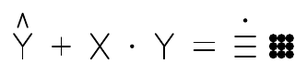
squares and ten roots balance thirty-nine.
The first specimen is al-Khwārizmī’s equation — squares and ten roots balance thirty-nine — carried whole into the strict notation: every mark is a presence, the balance is the assertion, and the numerals are bijective throughout. The reflection \(\rho\) acts on such terms with \(\rho(\rho t)\text{=}t\), and the renderer is equivariant: emitting the reflected term yields the page-mirror of the emission.
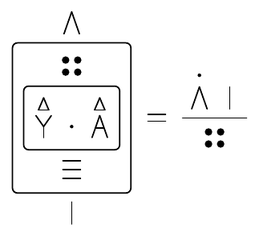
nested accumulation and its mirror, evaluated as twenty-one over four in the displayed finite example. General interchange still requires the applicable Tonelli or Fubini hypotheses.
The second specimen sets a nested accumulation beside its own page-mirror: one term, one reflection, both readings kept.
The exploratory evidence that the strokes carry their own reference is the caption-blind decoding audit reported in full in the volume. A language-model session (\(n\text{=}1\)) received plates with every caption withheld, under a staged prompt protocol, and recovered from the strokes alone: the bijective numeration and its rank system, the arithmetic operations, prime membership, the mirror closure of the term algebra, and the zeta–Euler-product identification — with self-reported confidences recorded in the volume. The audit also found a real defect: a vacant additive slot induced a [null-object] reading, and the repair is exactly the strict discipline WF6 now enforces. The audit is exploratory evidence, one reader, exactly as scoped; what it shows is the claim this section makes in pictures: the notation carries recoverable structure, the prose standing aside. In the volume’s own words: reference travels in the strokes; the keeping, as ever, is the cell.
Geometry and representative classical realizations
The presence-only regime recovers standard mathematics where standard mathematics is positively formed. Two samples are given at assertion-of-record strength.
Invariant carriers. For a reading surface \(\Sigma\) with symmetry group \(G\), lawful scalar carriers are the \(G\)-fixed functions, equivalently functions on the quotient \(\Sigma\text{/}G\); for the polynomial actions used in the source volume [5],
\[{\mathbb{R}}\lbrack x,y)^{{\mathbb{Z}}\text{/}2}\text{=}{\mathbb{R}}\left\lbrack x^{2},y \right),{\mathbb{R}}\lbrack x,y)^{C_{3v}}\text{=}{\mathbb{R}}\left\lbrack r^{2},\text{Re}\left( z^{3} \right) \right),{\mathbb{R}}\lbrack x,y)^{O(2)}\text{=}{\mathbb{R}}\left\lbrack r^{2} \right).\]
Orbit spans decompose into isotypic components and may decompose further; the tent, corner, and cone are geometric realizations of the actions (an interpretation, so labeled), and the folding/root correspondences of the volume are labeled theorem or interpretation per the taxonomy above. Two of those correspondences are quotable at record strength because they are classical facts wearing the calculus’s clothes: the resolvent cubic of the quartic is governed by the quotient \(S_{4}\text{/}V_{4} \cong S_{3}\) (the three pairings of four roots, ahead of the root-stabilizer picture), and the decisive radical obstruction for the generic quintic is the nonabelian simple factor \(A_{5}\) [6] — cyclic \(C_{5}\) extensions being radical-solvable, the wall is simplicity itself, beyond the prime five. The calculus’s right-folding family realizes exactly the \(2\)- and \(3\)-torsion tower, which is why the quintic stands outside it.
Counting by presence. The calculus’s counting constructions realize classical residue counting [7]: for a counting density \(N\) on a region \(\Omega\),
\[E\text{=}\frac{1}{2\pi i}\oint_{\partial\Omega}^{}N(z)dz,\]
with the degree-\(m\) cyclic factorization
\[n^{m} - l^{m}\text{=}\prod_{j\text{=}1}^{m}\left( n - \zeta_{m}^{j}l \right),n_{j\text{+}1}\text{=}\zeta_{m}n_{j}\]
exhibiting the deck orbit of the \(m\)-fold cover on which the count lives; tail subtraction is performed against the digamma comb \(\psi(\rho - z)\), whose poles at \(z\text{=}\rho,\rho\text{+}1,\rho\text{+}2,\ldots\) carry unit residues — the reference density of the shifted integer roster — so that a finite region’s count is the positively presented difference of two inscribed densities rather than a subtraction from an uninscribed infinity; the monodromy obstruction [8] records that a locally consistent count can stop short of globalizing across a branched cover — an obstruction the presence regime states as a roster held outside global formation, with its witness; and the heat-trace expansion contributes its topological term \(\chi(\Omega)\text{/}6\) [9, 10, 11], tying the counting geometry to the region’s Euler characteristic. The monodromy point deserves one more sentence, because it is the presence discipline paying rent inside classical mathematics. On a branched cover, a counting density can be locally consistent on every chart while the global count stays outside formation; and the distinction must be drawn exactly: for the connected double cover \(z \mapsto z^{2}:S^{1} \rightarrow S^{1}\) the global fiber cardinality is constantly two — the classical degree exists and is untouched — while it is the global labeled roster that stays outside formation: a trivialization, a section, a witness-identity-preserving enumeration of the fiber. The deck generator \(n \mapsto \zeta_{m}n\) permutes the sheets, and a transformation-invariant individuation is yet to present; in this paper’s terminology, a count retaining witness identity means a trivialization, and it is that stronger genealogical count which monodromy obstructs. The global roster is held outside formation, and the classical degree remains two; the cure — pass to the quotient, or present a section — is then visible as the formation act it is. The heat-trace term completes the sample from the spectral side: in the small-time Dirichlet heat-trace expansion on a planar domain, after the area and boundary-length terms the constant term is \(\chi(\Omega)\text{/}6\) — topology entering a count through a positively presented analytic object, the pattern the \(n\)-wave realization generalizes. Detailed verifications and the full formula apparatus are in the supplementary volume.
Intelligent decision systems: three concrete transfers
The engineering thesis is the mathematical thesis verbatim: every judgment in an intelligent decision system names its sponsor — a completion certificate, an exclusion, a rejection, or a coverage record.
A. Databases. The presence discipline models a domain by positive event and relation records: the schema’s inventory is its emitted events and relations, and the unrecorded cell has status (iii). The long-documented anomalies of the schema-layer [null] — three-valued comparisons, vanishing rows, aggregates over ghosts — are, on this analysis, the operational signature of [a surrogate zero installed in the schema layer]; the open-world reading of [absence], and event-sourced designs that store acts rather than states, are the industrial forms of presence-only formation, and the calculus supplies them a semantics in which the discipline is a formation law before it is a convention.
Concretely [12, 13]: the comparison [nullnull] stands short of truth in standard query semantics,\(\text{=}\) a row with a [null] join key silently vanishes from an inner join, and aggregates step over [null]s by a rule the analyst memorizes — three famous behaviors that are the necessary arithmetic of a reified non-presentation [rather than bugs], exactly as the surrogate-zero analysis predicts. The open-world assumption [3] is the presence-only reading of a database: a record's coverage certificate alone licenses a refuting conclusion. The closed-world assumption is lawful only when sponsored — when a completeness certificate for the relevant relation has itself been positively established, the coverage-event discipline in storage form. Event sourcing [14] makes the discipline architectural: the store holds acts (orders placed, payments received, holds released), each with its trace, and every state is a fold over acts, so [“the balance is zero”] is a derived report over a positively presented history, and an auditor replays the acts rather than trusting the slot.
B. AI and sparse data. In recommendation and ranking, the unclicked cell holds status (iii) [a click withheld is distinct from dislike, a rating withheld from a zero rating]: implicit feedback datasets are rosters of positive events, and treating the unobserved cell as [a semantic zero] is the reification, with measurable bias as its price. A feature withheld is a status-(iii) event [distinct from a zero-valued feature]; padding tokens and attention masks are machinery-layer controls (exactly the classification of the [empty-emission] marker above) and the semantic layer receives values only from witnessed emission. The presence discipline gives the engineering rule its foundation: the unobserved cell has status (iii) of Section 2 — withheld inscription — and models should be scored on positively witnessed events plus explicitly sponsored exclusions.
The implicit-feedback literature [15] already treats the unobserved cell as low-confidence — weighting observed events and shrinking the unobserved toward ignorance ahead of dislike — and the presence analysis says why that is the correct shape and where to hold the line: the unobserved user–item pair supports a place ahead of any semantic inscription, so any training signal assigned to it is a modeling convenience that must be labeled machinery, tuned as machinery, and kept out of every report that speaks of preferences. The same boundary governs padding and masking in sequence models: the pad token exists so tensors are rectangular, the mask so attention ignores the pad; both are renderer-layer controls in exactly the sense of the [empty-emission] marker above, and the moment a pad embedding leaks gradient into semantic predictions, machinery has crossed into meaning — the same category collapse the blind reader performed when offered a vacant additive slot. Evaluation should follow formation: score on positively witnessed events plus certificate-sponsored exclusions, and report coverage alongside accuracy, because an accuracy number over an unstated coverage is a tally standing apart from its roster. The reporting schema is one line: every published metric carries \(\left( \text{value};\text{roster size};\text{coverage certificate} \right)\), and a metric arriving short of its third field is, by the discipline, a status-(iii) report, its formation still ahead.
C. Decisions and safety. A decision pipeline should emit positively witnessed branches — \(Approved(\ldots)\), \(Rejected(\ldots)\), \(ReviewScheduled(\ldots)\) — each carrying its sponsor, and a rejection is a recorded \(Rejected\) event — the judgment and its sponsor are the same record; the approval withheld is status (iii), and its promotion to a rejection is [default falsity]. Likewise [“no hazards found”] is a coverage question standing open, and a safety fact arrives by certificate; the presence replacement is a positive readiness certificate carrying test scope, test traces, instrument traces, operator credentials, and a coverage record — a certificate in exactly the TPN sense, and auditable because every field is a trace of a performed act.
The safety case generalizes to a design rule for the audit trail itself. Every branch emission carries its sponsor inline — \(Approved\left( \text{req};\text{policy};\text{approver};\text{trace} \right)\), \(Rejected\left( \text{req};\text{clash};\text{trace} \right)\), \(ReviewScheduled\left( \text{req};\text{trigger};\text{slot} \right)\) — so the pipeline’s history is a roster of certificates — provenance in the standards sense [16] — and “why did the system do this” is answered by reading alone. The readiness certificate replacing [“no hazards found”] is the same object at system scale: \(Ready\left( \text{scope};\text{test traces};\text{instrument traces};\text{credentials};\text{coverage} \right)\), assertable exactly when its five fields are inhabited by performed acts [rather than assembled from the silence of detectors]. A worked pipeline makes the statuses operational. A loan application arrives: witness, inscribed with trace. Underwriting runs: if the policy engine emits \(Approved(\ldots)\), status (i), with the policy version and approver in the trace; if a credit check returns a positively witnessed disqualifier, the engine emits \(Rejected(\ldots)\) carrying the clash — status (ii), sponsored, appealable precisely because its sponsor is inscribed. If instead the bureau connection times out, the correct emission is the third: the application holds at status (iii) with a \(ReviewScheduled\) inscription whose trigger is the timeout event — and the system that instead auto-declines has promoted a network fault into a creditworthiness fact, which is default falsity with a customer attached. The audit answer to “why was this applicant declined” is then always a readable certificate [in place of a reconstruction from logs of what a withheld approval must have meant]. For system builders the discipline condenses to an assertion-record schema, stated once: every consequential record carries
⟨ statement ; register (the judgment form under which it holds) ;
sponsor (witness, clash, or certificate) ; trace ;
stratum (of record, superseded, historical) ;
edition (a recomputable hash binding the record to a source state) ⟩
— six fields, each exhibited doing real work in this paper: the register field in Section 8, the sponsor and trace fields throughout Section 2, the stratum field in the source volume’s self-corrections, and the edition field in the archive’s hash convention. A record arriving short of its sponsor is the engineering form of [a surrogate zero], and the schema makes the omission visible at the type level rather than discoverable at the postmortem. The general principle, displayed once because everything in this section is an instance of it:
Every judgment names its sponsor: a completion certificate, an exclusion, a rejection, or a coverage record.
The register-typed resolution of the Riemann question
Registers, compressed
Five registers govern the section’s verdicts, and the register theorem of the source volume states that every judgment passes from one to another through a named interface alone: \({Reg}_{Gra}\) (formation in the presence grammar \(G_{P}\)); \({Reg}_{Obj}\) (derivability in the adopted native theory); \({Reg}_{\omega}\) (omega-formation under the registered seal rule); \({Reg}_{Rel}\) (relative derivability and independence over the base calculus); and \({Reg}_{Cla}\) (classical analytic interpretation). In compressed tabular form:
| register | judgment form |
|---|---|
| \[{Reg}_{Gra}\] | formation in the presence grammar \(G_{P}\) |
| \[{Reg}_{Obj}\] | derivability in the adopted native theory \(P^{\dagger}\) |
| \[{Reg}_{\omega}\] | omega-formation under the registered Seal rule |
| \[{Reg}_{Rel}\] | relative derivability over the unextended base calculus |
| \[{Reg}_{Cla}\] | classical analytic interpretation \(I\) |
One caution binds the paper’s own side: rejecting classical primacy licenses marked presence claims alone. “Ill-typed” is a grammar-register judgment; the transcendental argument of Section 1 separately defends why that grammar should govern.
Nontranslation and formation
Proposition 1 (Every tally moves every tally). Let \(T\) be the set of pairing classes of nonempty finite rosters, with addition \(\oplus\) induced by disjoint concatenation. Then \(T\) is moved by every one of its elements. Consequently an identity-preserving homomorphism \(\left( {\mathbb{N}},\text{+},0 \right) \rightarrow (T, \oplus )\) sending classical numerals directly to presence tallies would require a tally that every element fixes, and every tally moves.
Proof. \(|R \oplus S)\text{=}|R)\text{+}|S)\text{>}|R)\) for every inhabited , so every roster class moves every other; an identity-preserving homomorphism would require a class every class fixes.\(S\)\(0\) ◻
Corollary. The literal zero-normalized formula \(\xi(s)\text{=}0\) is translated into the tally grammar through a priced interface alone. Relational encodings, partial-evaluation semantics, or completion constructions remain possible — but only as explicitly priced interfaces, which is what clause 6 of Theorem 3 supplies.
The conventional zero-locus sentence of the Riemann hypothesis is an instance. One statement of exactness first, so the foundational disagreement is located precisely rather than appearing factual: in classical semantics \(\xi\) is \(\mathbb{C}\)-valued and \(\xi(s)\text{=}0\) is a perfectly formed equality. The presence interpretation \(I_{P}\) retypes the relevant evaluation as a partial \({\mathbb{C}}^{\times}\)-valued map; under that declared interpretation, a classical zero corresponds to an exit from the presence-valued codomain. The formation theorem below is therefore a theorem of the presence interpretation — the paper’s chosen grammar — and classical syntax stands by its own rules. With that fixed: the presence grammar holds the zero-locus sentence outside formation; it is refused at formation, held outside formation in \(G_{P}\) because it converts an exit of presence-valued evaluation into equality with a numerical object. The mathematical subject survives and is reconstructed as the native axis statement — an independently constructed native sentence about positively presented data:
\[{RH}_{C}^{(0)} \notin Sent\left( G_{P} \right),{RH}_{M} \in Sent\left( G_{P} \right).\]
(Classical background on \(\xi\) and its zeros: [17].) Here \({RH}_{M}\) reads: every exit locus of the completed prime-fused descent is fixed by the mirror-axis involution, where an exit locus is a positively presented parameter at which presence-valued evaluation ceases to form under the native partial semantics — a formation event, inscribed with its trace, running on presented data alone. The partial semantics beneath the definition deserves a sentence more. Presence-valued evaluation assigns to each presented parameter the positively formed value of the completed descent where one forms; it is a partial map by design, with \(Eval \uparrow\) the metalanguage record of non-formation. An exit locus is thus doubly positive: the parameter is presented (with its trace), and the cessation is an inscribed formation event — the evaluation procedure completing with a withheld emission and a certificate of the attempt — so the native sentence quantifies over records of acts alone. This is what it means, exactly, that the reconstruction runs on presented data alone. The underlying question is grammar-robust rather than dissolved: refused in one sentence-form, reconstructed and answered in another, with the correspondence priced below.
Clause 5 of the theorem below references the completion apparatus, stated here since the clause carries real weight. A coherent omega-kept family is a presented object \(K\text{=}\left( k_{n} \right)_{n \in {\mathbb{N}}}\) with \(Keep\left( n,k_{n} \right)\) and \(k_{n} \preccurlyeq k_{n\text{+}1}\); the Omega-Seal rule forms the terminal seal from the presented family, its premise; the stagewise statement \(\forall n\exists k_{n}Keep\left( n,k_{n} \right)\) supplies the stages, and the family forms by one of the three constructors. The Selection-Jump theorem makes the refusal a theorem: a coherent family forms by a presented family, a guarded generator carrying its uniform keeping law, or an explicit occupation sponsor, and finite occupation of every separately presented stage is a record at each stage. The rule and the theorem are the fractal-continuation stipulation of Section 3 arrived at formal maturity, and they are the reason clause 5’s entailment is lawful while its silent classical counterpart would be selection smuggling. The paper’s option is declared in full: under the witnessed semantics the source volume sponsors the coherent omega-kept family as a completed formation object — an adopted completion postulate recorded by the sponsorship rule of Section 2, an adoption rather than an analytic derivation — so \({Reg}_{\omega}\) carries an actual sponsored verdict, priced exactly like every other adoption in this paper; the entailment of clause 5 additionally assumes the named clash-channel interface, under which an off-axis exit record yields an accepted finite address that the sponsored family’s covering stage rejects.
Alongside the native sentence, three forms carried by the source volume’s assertion of record are proved classically equivalent to the classical hypothesis, anchoring the reformulation on the classical side as well: R1, all roots of \(\Xi(t)\) are real; R2, every exit locus of \(\xi\) is fixed by \(s \mapsto 1 - \overline{s}\); and R3, every exit-locus orbit under the Klein four-group generated by \(s \mapsto 1 - s\) and \(s \mapsto \overline{s}\) has size at most two — R3 together with the classical fact that \(\xi\) has every exit locus off the real line. (The axis, balance, and kept-region readings used informally above are three native faces of these; the numbered forms are the forms of record.) A former fourth form is retained at exactly its provable strength:
Proposition 2 (Odd-multiplicity detection). An exit locus on the real parameter axis of odd multiplicity — in particular a simple one — is detected by a sign reversal of the real completed function; even-multiplicity loci can hold their sign. Detection is elementary real analysis — a consequence of odd multiplicity alone — and it stands beside the three equivalences of record.
The conditionalization is itself a stratum event of the source volume’s taxonomy: the unconditional form is superseded, its successor is the assertion of record, and the equivalence theorem is titled for three forms.
One more sentence on why the question is grammar-robust rather than dissolved, since dissolution is the standard fate of questions declared ill-formed. When a positivist declares a metaphysical sentence meaningless, the sentence’s subject matter ends there; the presence analysis does the opposite work. The zero-locus sentence is held outside formation for a stated, local reason — one criterion clause reifies non-presentation — while every mathematically load-bearing ingredient (the completed descent, the prime genealogy, the mirror involution, the exit events) is positively formable; so the subject matter survives its sentence-form, and the native reconstruction is the same topic carried by lawful syntax. The proof of robustness is the interface theorem itself: clause 6 exhibits a classical-side sentence provably equivalent, under \(I\), to the adopted native axiom, so the classical and native formulations demonstrably orbit one subject. A question is dissolved when its formalization is exhausted by the dissolution; this one leaves, on the account given here, its entire mathematical content.
The consolidated resolution
Theorem 3 (Register-Typed Resolution of the Riemann Question). Let \({RH}_{C}^{(0)}\) be the conventional zero-locus sentence and \({RH}_{M}\) the native axis sentence.
\({RH}_{C}^{(0)} \notin Sent\left( G_{P} \right)\).
\({RH}_{M} \in Sent\left( G_{P} \right)\).
\(P^{\dagger}\text{=}P\text{+}{Adm}_{\zeta}\) derives \({RH}_{M}\), where Native Admission is adopted as a foundational presence law by an explicit, priced Sponsorship Declaration — a recorded foundational act whose price is stated exactly by clause 6. What licenses the adoption is a theorem about routes. Every sound resolver fully invariant under replacement of one exact selected package by another is [identically empty], so every sound sign selector uses data beyond selected architecture; every sound route that does form a sign must therefore expose the point at which it stops so factoring, and that point is an occupation, a derivation, a coordinate theorem, a stream, or an oracle. The Sponsorship Declaration is that exposed point, named in advance rather than recovered by audit: it constitutes the theory, carries its sponsor, is marked at its stratum, and has its classical price stated exactly by clause 6. A route forming a sign while keeping its [non-invariant] effect off the page is convicted by the hypothesis-tethering theorem; a route whose formations and exposures both stand bare is already absorbed in the maximal selected closure [the volume's third class]; the two classes exhaust. Clause 3 carries its own licence; clause 4 stands beside it.
The unextended base calculus leaves class-wide Admission and class-wide Counter-Admission both underived (Theorem 4).
A presented or explicitly sponsored omega-kept family entails \({RH}_{M}\) under the registered Omega-Seal rule together with the named clash-channel interface; the passage from stagewise availability to a formed family is a Selection Jump, sponsored every time.
Under the classical interpretation \(I\), \(I\left( {Adm}_{\zeta} \right) \Leftrightarrow {RH}_{C}\).
Reflection symmetry locates the axis and leaves occupation open (Theorem 5).
A judgment passes from one clause to another through the named interface alone. Together these clauses exhaust the paper’s use of “resolved.”
This paper accordingly claims a foundational and register-typed resolution of the Riemann question — a resolution of its own kind, register-typed and priced. The paper seeks its derivation in the presence grammar with a priced interface, having set the classical sentence-form aside as the governing formulation. Its claim is a foundational resolution: rejection at formation, native reconstruction, explicit theory selection, completion rule, relative model fork, and exact classical interface.
Two definitional notes complete the section’s typing. First, two Admission sentences are distinguished: \({Adm}_{class}\), the class-wide schema over abstract distinct-genealogy, prime-labelled, sector-conditioned descents, and \({Adm}_{\zeta}\), the unique instance fixed by categoricity clauses (full prime genealogy, harmonic plenum, mirror completion) that pin the zeta descent — the Reference theorem of the source volume, proved via Hamburger’s converse theorem [18] under its stated hypotheses. The independence result below concerns the schema; the interface of clause 6 concerns the instance; and the polynomial models below are excluded from the instance by categoricity while deciding the schema — consistent once typed. Second, the relative register carries one classical metatheorem worth restating with its hypotheses exact: if a \(\Pi_{1}\) representative is independent of a sound, sufficiently arithmetically strong and \(\Sigma_{1}\)-complete theory, then it is true in the standard arithmetic interpretation — were it false, its true \(\Sigma_{1}\) counter-inscription would be provable. (An effective arithmetic \(\Pi_{1}\) representative of RH is classical [19].) The door between independence and arithmetic truth opens one way, and the volume states it with these hypotheses attached rather than leaning on it. The metatheorem stops short of Theorem 4: relative independence over the base calculus is a fact about the base, and a truth conclusion asks for independence over an arithmetically adequate theory.
The interface \(I\) of clause 6 is defined in full: it maps the native completed descent to \(\xi\), exit loci to classical zeros, the mirror involution to \(s \mapsto 1 - \overline{s}\), the mirror axis to \(\text{Re}s\text{=}\frac{1}{2}\), and zeta-specific Admission to the classical critical-line assertion, whence the biconditional of clause 6 follows directly; a second, equivalent expression of the same classical price is Weil positivity,
\[W\left( f\text{*}\overset{\sim}{f} \right) \geq 0\text{for every admissible }f,\]
\[\text{native:}\overline{Pres}\left( W\left( f\text{*}\rho f \right) \right),\]
since \(\overset{\sim}{f}\text{=}\rho f\); \(\overline{Pres}\) is the closed positive sector, presented or seam.
which Weil’s criterion [20], under its standard analytic hypotheses and normalization, makes a second route to the same \(I\left( {Adm}_{\zeta} \right) \Leftrightarrow {RH}_{C}\); Hamburger’s converse theorem belongs to the separate Reference/categoricity result; the Weil interface stands on its own. The classical statement enters the architecture here and here alone: as the priced shadow of the adopted native law. The interface is supported computationally in the source volume by a Weil explicit-formula ledger under a fixed normalization: positivity of the spectral margin at displayed Gaussian parameters, each row carrying its truncation, analytic tail budget, and an independent-precision stability comparison. Those computations have the third assurance grade of Section 4 and are cited at that strength.
The criterion neighbourhood should be named plainly, and its limits with it. Zeta-specific Admission is an axis-admission law; the positivity criteria are its equivalent faces under the interface. Distinctly, the stiffness field Re(ξ′/ξ) carries a positivity property that is itself a known classical equivalent of the hypothesis, established independently by Hinkkanen [26] and Lagarias [27] and studied downstream [28]; the same field separates Models A and B. Since the interface theorem already states that I(Admζ) is of exactly classical strength, the existence of classically equivalent criteria is expected rather than informative. Occupation of a sign fibre asks for more than availability of an exact criterion: equivalent criteria are absorbed as fibres of one package, and a verdict forms at a sign fibre alone.
Relative independence, with proof
Theorem 4 (Relative Independence of Class-Wide Admission). \(P \nvdash {Adm}_{class}\) and \(P \nvdash {CounterAdm}_{class}\).
Proof. The conditioned field of a descent \(D\) with root multiset \(\{\rho_{j}\}\) is \(\Phi_{D}(s)\text{=}\sum_{j}^{}\text{Re}\frac{1}{s - \rho_{j}}\text{=}\text{Re}\left( F\prime_{D}\text{/}F_{D} \right)(s)\) for \(F_{D}(s)\text{=}\prod_{j}^{}\left( s - \rho_{j} \right)\); class-wide Admission asserts \(\Phi_{D}(s)\text{>}0\) for every descent at every presented point strictly right of the seam \(\sigma\text{=}\frac{1}{2}\), and its counter-inscription is
\[{CounterAdm}_{class}: \equiv \exists D\exists s\left( \text{Re}s\text{>}\frac{1}{2} \land \Phi_{D}(s)\text{<}0 \right).\]
\[\text{native:}\begin{matrix} {Adm}_{class} & :\forall D\forall s\left( {sec}^{\text{+}}(s) \Rightarrow Pres\left( \Phi_{D}(s) \right) \right), \\ {CounterAdm}_{class} & :\exists D\exists s\exists m\left( {sec}^{\text{+}}(s) \land Pres(m) \land \Phi_{D}(s) \doteq \rho(m) \right), \end{matrix}\]
with \({sec}^{\text{+}}\) the positive-sector typing against the seam, \(Pres\) the presented-magnitude judgment, \(\rho\) the page-mirror, and \(\doteq\) the kept balance. Both models interpret the grammar and junction-algebra modules identically, so the shared axioms hold in both; they differ only in the descent module. Model A (seam): descents are the nonempty finite seam-root multisets, \(\rho\text{=}\frac{1}{2}\text{+}i\gamma\), closed under nonempty fusion; for \(\sigma\text{>}\frac{1}{2}\),
\[\text{Re}\frac{1}{s - \left( \frac{1}{2}\text{+}i\gamma \right)}\text{=}\frac{\sigma - \frac{1}{2}}{\left| s - \left( \frac{1}{2}\text{+}i\gamma \right) \right)^{2}}\text{>}0,\]
\[\text{native:}Pres\left( \frac{d(s)}{sep(s,\frac{1}{2}\text{+}i\gamma)^{2}} \right),\]
\[Pres\left( d(s) \right),Pres\left( sep\left( s,\frac{1}{2}\text{+}i\gamma \right) \right),\]
\(d(s)\) the seam displacement of \(s\) and \(sep\) the separation of two presences, each presented by formation.
so \(\Phi_{D}\text{>}0\) term by term: Admission holds. Model B (witness): descents generated by the quadruple \(\{\frac{4}{5} \pm 5i,\frac{1}{5} \pm 5i\}\); at the presented rational point \(s\text{=}\frac{3}{5}\text{+}5i\) the four terms evaluate exactly to \(- 5\), \(- \frac{5}{2501}\), \(\frac{5}{2}\), \(\frac{5}{1252}\), and
\[\Phi\left( \frac{3}{5}\text{+}5i \right)\text{=} - \frac{7821885}{3131252}\text{<}0,\]
\[\text{native:}\Phi\left( \frac{3}{5}\text{+}5i \right) \doteq \rho\left( \frac{7821885}{3131252} \right),\]
verified in exact rational arithmetic by the script shipped with the archive; Counter-Admission is witnessed. Both structures model the unextended base theory; both sentences stand underived. ◻
Object-language forms and the introspective reading
Each classical inequality display in this paper is paired in place with its object-language form, under one dictionary: \(\doteq\) is the kept balance, \(\rho\) the page-mirror, \({sec}^{\text{+}}\) the positive-sector typing against the mirror seam, \(Pres\) the presented-magnitude judgment, \(\overline{Pres}\) its closed form (presented or seam), \(d(s)\) the seam displacement, \(sep\) the separation of presences, \(\prec_{R}\) roster precedence, and \((T, \oplus )\) the tally semigroup. The pairs make the independence theorem manifest introspectively: Model B is the Scene the native \({CounterAdm}_{class}\) form describes — Witness of the descent, Witness of the parameter with its sector typing, Inscribe of the mirror-typed observation \(\Phi \doteq \rho(m)\) — while Model A is a Scene whose every field observation satisfies \(Pres\); the unextended base houses both Scenes, and adoption selects between them. Equalities throughout retype uniformly as kept balances and strict comparisons as sector typings against the seam; the theorem, read introspectively, is one sentence: the base keeps both the all-positive Scene and the mirror-bearing Scene, each standing underived from it, and the selection is the foundational act.
The theorem is relative to the exact many-sorted signature and axiom table (A1–A16) reproduced in the source volume’s independence appendix; the shared grammar and junction-algebra rows are discharged there by the cited kernel and soundness theorems and inherited by both models. The exact-arithmetic script verifies the displayed fraction; the model axioms carry their own verifications, and the paper claims each at its own grade.
Scope. The theorem is internal to the native base calculus and its consequence relation, and it concerns the class-wide Admission schema. The native base and consequence relation are defined independently of incumbent arithmetic and set-theoretic foundations; the theorem is stated solely in the native relation, and external foundations enter only through separately defined formation-faithful interpretations. The zeta-specific instance is separately fixed by the Reference and Interface theorems of the source volume; the exclusion of polynomial witnesses from that instance is a categoricity fact about the reference clauses, consistent with Model B’s role for the class-wide schema once the instances are typed.
The Symmetry No-Go
Theorem 5 (Symmetry No-Go). Reflection symmetry locates the axis and leaves occupation open. Witness: \(F(s)\text{=}\left( \left( s - \frac{1}{2} \right)^{2} - a^{2} \right)\left( \left( s - \frac{1}{2} \right)^{2} - {\overline{a}}^{2} \right),a\text{=}\frac{3}{10}\text{+}7i.\) Then \(F(1 - s)\text{=}F(s)\) (both factors depend on \(\left( s - \frac{1}{2} \right)^{2}\), which the substitution fixes) and \(F\left( \overline{s} \right)\text{=}\overline{F(s)}\) (the root set \(\{\frac{1}{2} \pm a,\frac{1}{2} \pm \overline{a}\}\) is conjugation-closed, so the coefficients are real), yet the exit loci include the generic off-axis orbit \(\frac{1}{2}\text{+}a\text{=}\frac{4}{5}\text{+}7i\) and its images.
The mirror locates the symmetry architecture and leaves the exit-locus geometry to the prime data. The zeta-specific proof obligation must use data beyond the witness — the prime genealogy, the completed arithmetic structure, or an equivalent Admission law. The witness merits one paragraph of reading. Its two displayed symmetries are precisely the functional-equation and reality constraints the completed zeta function satisfies, so the witness sits inside the symmetry class where a naive argument would like to conclude axis occupation — and its exit loci sit at \(\sigma\text{=}\frac{4}{5}\) and \(\sigma\text{=}\frac{1}{5}\), a full mirror-symmetric orbit off the axis, jointly closed under both symmetries. Symmetry constrains exit loci to mirror-closed configurations; the fixed-point configuration among them is selected by further data. The gap between the two is exactly the content of Native Admission, which is why the program prices that content as an axiom rather than sliding it under the reflection. This theorem is an internal self-correction of the program, recorded as such: the native theory keeps symmetry and axis occupation distinct, and clause 7 of Theorem 3 is its inscription.
What would change the verdicts. The architecture is falsifiable clause by clause, and stating how is part of stating it. A derivation of \({Adm}_{class}\) or its counter-inscription from the base calculus would refute Theorem 4 and collapse clause 4; a descent satisfying the full Reference clauses and possessing an off-axis exit locus would refute \({Adm}_{\zeta}\) and, through the classical interface, classical RH — the Reference theorem stands on its own hypotheses; an identity-preserving homomorphism \(\left( {\mathbb{N}},\text{+},0 \right) \rightarrow (T, \oplus )\) carrying numerals to tallies would refute Proposition 1 and reopen clause 1’s route; and a classical disproof of \({RH}_{C}\) would, through clause 6, make the classical interpretation \(I\left( {Adm}_{\zeta} \right)\) false and reclassify the Sponsorship Declaration as an adoption whose classical shadow fell — register noncollapse preventing that outcome from being stated as an untyped contradiction inside the native theory, which is the stratum discipline surviving with its audit trail intact. The program’s claims are arranged so that each has a named defeater, and the registers say exactly which other claims each defeat would touch, and which it would leave standing.
What the classical reader must check
The architecture asks a skeptical classical reader for finitely many verifications, each self-contained. Clause 1 of Theorem 3: inspect the grammar’s atom inventory and formation rules and confirm that every term is formed by an act and that every equality criterion compares presented values — a syntax check. Proposition 1: confirm \(|R \oplus S)\text{=}|R)\text{+}|S)\text{>}|R)\) bars an additive identity in the tally sort — one line of counting. Clause 3: read the Sponsorship Declaration and confirm the adoption is explicit — a bookkeeping check. Clause 4: run the shipped script; confirm \(- 7821885\text{/}3131252\) and the seam identity — an afternoon with exact arithmetic. Clause 5: confirm the Seal rule’s premise is a presented family and that every family forms by one of the three constructors — a proof-theory check. Clause 6: verify the interface against the Weil functional and Hamburger’s hypotheses — classical analysis, cited to its sources. Clause 7: substitute \(a\text{=}\frac{3}{10}\text{+}7i\) into the displayed witness and confirm both symmetries and the off-axis loci — five lines of algebra. A reader who completes the checklist has verified every assertion of this paper at its stated register, whatever foundation the reader keeps.
Conclusion and limitations
Limitations, exactly scoped: Lean certifies the named core fragment, with the vertical constructors and full well-formedness refinements staged; the current Lean artifact, moreover, places the [empty-emission] control in its implementation datatype and enforces its positions through the well-formedness predicate — the stricter PreTerm/Term separation, adopted semantically in this article, is staged for formalization, so kernel certification concerns the implementation control syntax, with the complete strict object-language distinction staged; the numerical ledger supporting the classical interface carries analytic budgets and a stability comparison, with outward-rounded interval certification pending; the Transport lemma is conditional on its dictionary hypothesis; and the Descent axioms are adopted formation laws, so their consequences are theorems of the adopted foundation, claimed as such.
A reader who accepts this paper accepts, exactly: one philosophical thesis (presence-only formation, defended transcendentally and adoptable or refusable as a foundation); a family of stipulations (the TPN and Descent formation laws, labeled as adopted); a set of theorems relative to those stipulations (the no-zero theorem [every term carries an inhabited count], the mirror metatheorem on its certified fragment, Propositions 1–2 and Theorems 3–5); two implementation facts (the kernel and checker certifications, at their stated scopes); and one engineering principle whose force is independent of the foundation (the displayed rule of Section 7, which a fully classical reader may adopt on its merits). The invoice above is the whole of it, and its registers are the instrument that keeps the invoice itemized.
The Mirror Calculus begins with formation, ahead of the question whether [a zero-normalized sentence] holds under its classical interpretation. It first asks whether that sentence is lawfully formed. Presence-only formation rejects the reification on which the conventional zero-locus sentence depends. The Riemann question is then reconstructed as an axis statement about positively presented exit loci. Its grammatical formation, native derivation, omega completion, relative model fork, and classical analytic interface are stated in noncollapsing registers. This exhaustive architecture is the paper’s foundational resolution. The same discipline applies to intelligent decision systems: data are emitted records, judgments carry their sponsors, and every consequential inscription carries the positive procedure by which it formed.
The companion paper: Deprogramming Zero
The programme now carries a second paper, Deprogramming Zero: Peano’s Axioms Without the Sign for Non-Presentation, the One Kept Record, and the Resolution of the Riemann Question at Its Registers (Emmerson, 2026; full text, PDF, and LaTeX source at theriemannhypothesis.com/papers/deprogramming-zero.html). It takes the sign out of the arithmetic every classical reader already accepts, and carries the result through algebra, set theory, and the Riemann question. This section summarizes it in the order it is written.
The four zeroations. Peano Arithmetic uses its constant 0 in exactly four ways — as a named point, as the origin from which every successor chain starts, as the base of the recursions for addition and multiplication, and as the base of induction — and each is an instance of the contradiction: a formed sign standing for a non-presentation in a positive position. Tally arithmetic TA, the first-order theory of the positive integers in the language {1, S, ⊕, ⊗} with induction from the unit, has every term formed by an act, the sign and its surrogates held in the metalanguage; its unit 1 is formed by the first act and stands for that act, so formation and office agree.
The bridge and the ledger. A formation-faithful interpretation carries PA into TA and a converse carries TA into PA; the two are bi-interpretable and equiconsistent, which is the sign’s formal usability and the whole of what the objection from usability establishes. The interpretation has a shape: PA’s operations, carried into the positive structure, are the native ones plus a predecessor at every zeroation, and each predecessor is a witness obligation the classical notation owed and discharged in silence. A ledger counts five substitutions, four concealed obligations, and one kept record. The first operation at which a concealed obligation comes due is division: at the image of the classical divisor 0 the predecessor stands outside formation, TA withholds it as a metalanguage judgment, and PA, required to return a term, writes [“undefined”] — a surrogate zero by the test. The semantic error becomes a bookkeeping error at exactly that operation.
The one kept record. By Lyndon’s preservation theorem, positive first-order logic has the circle ℤ/k among its models wherever it has the line, so the statement that the unit is the origin of every successor chain is held as one kept record, independent of the positive fragment, with ℕ>0 and ℤ/k as the two witnessing models. This proves that TPN’s placement of the terminus in the metalanguage is forced rather than chosen: in the positive coherent fragment of Counting Back from Infinity the one-point structure satisfies every sequent. A general schema extends the elimination to every theory whose zero is the least element of a discrete order; heap theory removes the identity of a group and truss theory the zero of a ring, both surrogates by the test; and [the empty set] — [the collection “with no member”] — the surrogate of set theory, is a kept record forced by Separation for formulas outside the positive fragment and by the ∈-induction schema, with set-level Foundation alone leaving a chain of singletons standing.
The independence theorem, generalized. For every consistent theory in the descent signature, Admission is independent exactly when the theory has an axial model and an off-axial model — consistency the whole hypothesis — and the class-wide theorem of the source volume is the case of the base with Models A and B. The generalization is as wide as independence can be: a theory faithful to ζ, one whose models agree with the standard structure on zeta-specific Admission, decides the zeta instance, in the direction the classical hypothesis takes. This is the Faithfulness Fork and the Conservation-of-difficulty remark of the source volume made into theorems, and it states what the zeta-specific transfer that Against Zero names as the exact next bridge would cost.
Why the sign was the obstacle. Written with the sign, the hypothesis is [a universal over the plane whose matrix is an evaluation set equal to the sign], which positive logic holds as a record and arithmetic makes Π₁, so that its affirmation is an ω-inference with its sponsor left off the page; the certification asymmetry between a refuting resolution and an affirming one is grammatical before it is arithmetic. The verification ledger presents two tallies at every stage — the argument-principle count and the sign-change count — and the evaluation ξ(ρ)=0 belongs to the classical description of the result. Riemann’s completion ξ had already removed the surrogate zeros of ζ, the exits of the gamma normalization. And in the explicit formula each zero of ξ is a presented carrier of weight x to the power Re ρ, so that the Admission law is a law about the weights of presented records: every carrier presents with weight √x.
The primes. Under the analytic interface the Admission law is Lagarias positivity, Re ξ′/ξ > 0 right of the axis, which is Li’s criterion λₙ ≥ 0 for all n, whose coefficients Bombieri and Lagarias write as archimedean terms minus a sum over prime powers — the positivity λₙ ≥ 0 of a prime-indexed sequence. The mirror pairs carriers whose weights multiply to x, and Admission says every pair splits x evenly. Pólya’s function and the Davenport–Heilbronn function are the axial and off-axial models of the analytic base stated short of the Euler product, so the content of the law lies in the prime-fused filter for Dirichlet series as well as for polynomials. And each kept stage of the ledger is a prime-counting bound on a segment, by Büthe’s theorem, with the seal Schoenfeld’s bound on every segment at once.
The resolution at its registers. Counting the constructors of the Selection Jump against the Emmerson–Buchanan barrier hierarchy, the explicit sponsor is the terminal constructor for the zeta family. The question is then resolved at its registers: the classical statement is delivered under the interface by an equivalence proved from the interface’s definition; the trace of the verdict is printed; the constructor is the one the question admits; and the clash channel stays armed. A co-guardianship theorem proves that the resolution and the barrier result each name the other’s refuter, that the two refuters exclude each other by soundness, and that under every event the record re-forms with a named trace. The verdict of record is the one this summary’s Theorem 3 states, carried to its maximum assertion: RH_C holds under I, sealed, sponsored, and armed, and the naming of the trace exhausts the verdict.
Availability
The complete source volume (The Mirror Calculus: A Presence-Only Mathematical Language), its LaTeX and Word editions, the reference implementation, the Lean files with pinned toolchain and checksums, the exact-arithmetic verification script and executed notebook, and the build manifest constitute the edition of record, prepared for public deposit at Zenodo under CC-BY 4.0, reserved DOI 10.5281/zenodo.21669457, activated on publication of the deposit. The edition identifier and the full SHA-256 digest are recorded in the build manifest, which is authoritative for those facts once the archive is frozen; the mathematical source stands free of any hard-coded source, artifact, or archive hash. This paper is the edition’s condensed statement of the assertions of record [21].
AI assistance statement
Portions of this paper and of the underlying volume were prepared with assistance from Claude (Anthropic) and ChatGPT (OpenAI), large language models used under the author’s direction for drafting, LaTeX engineering, software implementation, structural review, and iterative technical audit. All mathematical content and positions are asserted by the author, who takes full responsibility. Machine verification cited here is executable and reproducible by the reader's own machine alone. The author of this work is Parker M. D. Emmerson; every AI contribution is tool-use under the statement above.
References
[1] E. Bishop, Foundations of Constructive Analysis, McGraw–Hill, 1967.
[2] P. Martin-Löf, Intuitionistic Type Theory, Bibliopolis, 1984.
[3] R. Reiter, On closed world data bases, in H. Gallaire and J. Minker (eds.), Logic and Data Bases, Plenum, 1978, 55–76.
[4] L. de Moura and S. Ullrich, The Lean 4 theorem prover and programming language, Proc. CADE 28, Springer LNCS 12699, 2021, 625–635.
[5] B. Sturmfels, Algorithms in Invariant Theory, 2nd ed., Springer, 2008.
[6] D. A. Cox, Galois Theory, 2nd ed., Wiley, 2012.
[7] L. V. Ahlfors, Complex Analysis, 3rd ed., McGraw–Hill, 1979.
[8] A. Hatcher, Algebraic Topology, Cambridge University Press, 2002.
[9] M. Kac, Can one hear the shape of a drum?, Amer. Math. Monthly 73 (1966), 1–23.
[10] H. P. McKean and I. M. Singer, Curvature and the eigenvalues of the Laplacian, J. Differential Geom. 1 (1967), 43–69.
[11] P. B. Gilkey, Invariance Theory, the Heat Equation, and the Atiyah–Singer Index Theorem, 2nd ed., CRC Press, 1995.
[12] E. F. Codd, Extending the database relational model to capture more meaning, ACM Trans. Database Syst. 4(4) (1979), 397–434.
[13] L. Libkin, Incomplete data: what went wrong, and how to fix it, Proc. ACM PODS 2014, 1–13.
[14] M. Fowler, Event sourcing, martinfowler.com, 2005 (accessed 2026-08-01).
[15] Y. Hu, Y. Koren, and C. Volinsky, Collaborative filtering for implicit feedback datasets, Proc. IEEE ICDM 2008, 263–272.
[16] W3C, PROV-DM: The PROV Data Model, W3C Recommendation, 2013.
[17] E. C. Titchmarsh, The Theory of the Riemann Zeta-Function, 2nd ed. (rev. D. R. Heath-Brown), Oxford University Press, 1986.
[18] H. Hamburger, Über die Riemannsche Funktionalgleichung der \(\zeta\)-Funktion, Math. Z. 10 (1921), 240–254; 11 (1921), 224–245; 13 (1922), 283–311.
[19] J. C. Lagarias, An elementary problem equivalent to the Riemann hypothesis, Amer. Math. Monthly 109 (2002), 534–543.
[20] A. Weil, Sur les “formules explicites” de la théorie des nombres premiers, Meddelanden Lunds Univ. Mat. Sem. (Comm. Sém. Math. Univ. Lund), Tome Supplémentaire dédié à Marcel Riesz (1952), 252–265.
Program corpus and data
[21] P. M. D. Emmerson, The Mirror Calculus: A Presence-Only Mathematical Language, Zenodo, 2026. Edition of record, CC-BY 4.0; source identifier and full SHA-256 recorded in the build manifest; reserved DOI 10.5281/zenodo.21669457.
[22] P. M. D. Emmerson and R. J. Buchanan, Riemann-Hypothesis Witness Fibres, Quantitative \(\Theta\)-Atlas \(\Xi\)-Certificates, Criterion Absorption, Nullity Matching, and Universal Selected Logical Nullity, Preprints.org (2026), DOI 10.20944/preprints202601.2410.v2. [Cited at the Sponsorship Declaration, the irresolvability–independence distinction, and the unification.]
[23] P. Emmerson (Yaohushuason), Bell–CHSH Under Setting-Dependent Selection: Sharp Total-Variation Bounds and an Experimental Audit Protocol, Quantum Reports 8 (2026), no. 1, article 8, DOI 10.3390/quantum8010008.
[24] P. Emmerson, Phenomenological Velocity and Bell–CHSH: Exceptional-Locus Semantics, Selection Simulations of \(- \cos\), and a Microcausal Realization, International Journal of Quantum Foundations 12 (2026), no. 2, 210–247.
[25] P. Emmerson (Yaohushuason) and R. J. Buchanan, Alternating Slices of the \(A_{2k - 1}\) Theta Series (dataset), Zenodo, version v2, 9 July 2026, DOI 10.5281/zenodo.21265022. Version v1 published as Sigma-Adic Numerations (P. Emmerson), 27 March 2024, DOI 10.5281/zenodo.10888345; all versions: DOI 10.5281/zenodo.10888344.
[26] A. Hinkkanen, On functions of bounded type, Complex Variables Theory Appl. 34 (1997), 119–139.
[27] J. C. Lagarias, On a positivity property of the Riemann ξ-function, Acta Arith. 89 (1999), 217–234; Correction, Acta Arith. 116 (2005), 293–294.
[28] E. Goldštein and A. Grigutis, On a positivity property of the real part of the logarithmic derivative of the Riemann ξ-function, J. Math. Inequal. 18 (2024), no. 3, 829–845.
[26] P. Emmerson, The Selection Jump (program manuscript; the formation-rule study of the omega chapter). Archival identifier to be affixed at deposit; cited here as a program manuscript of this corpus.
[27] P. Emmerson, Witnessed semantics for presence-only verdicts (program manuscript).
© 2026 Parker M. D. Emmerson. All rights reserved.