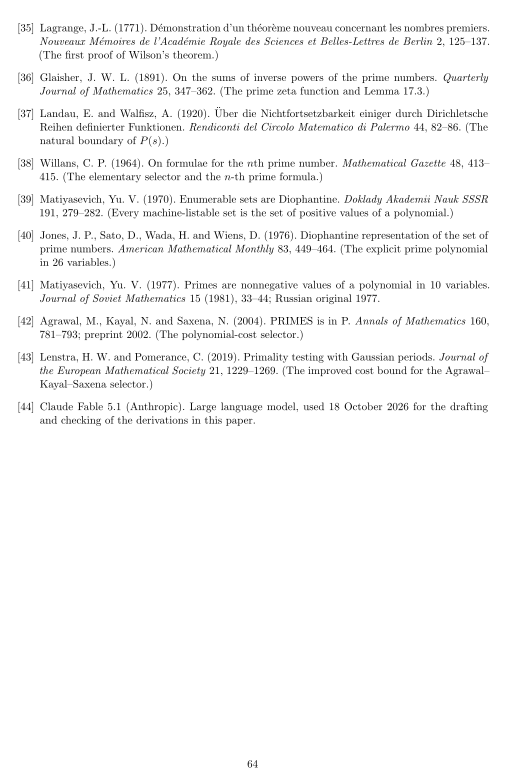
From Euler’s Series to Riemann’s Zeta Function

The Explicit Derivation of the Analytic Continuation and the Functional Equation, with Every Step Written Out and Every Construction Drawn

Parker Emmerson (Yaohushuason) · 18 October 2026 · © All rights reserved

Abstract

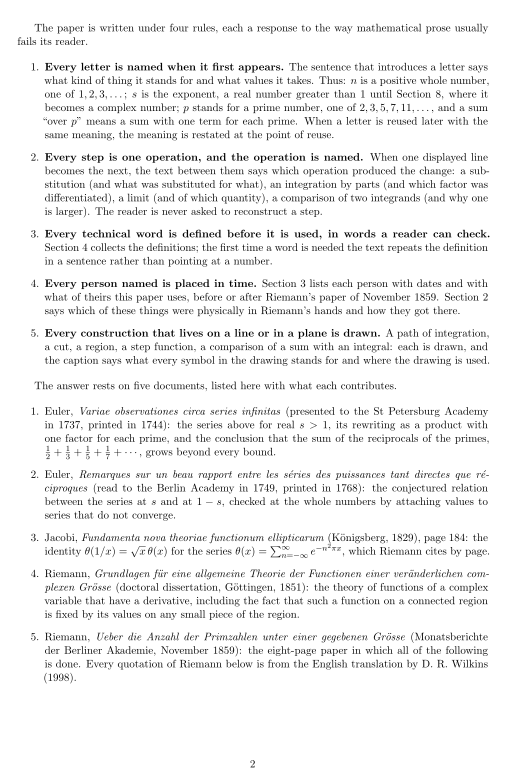
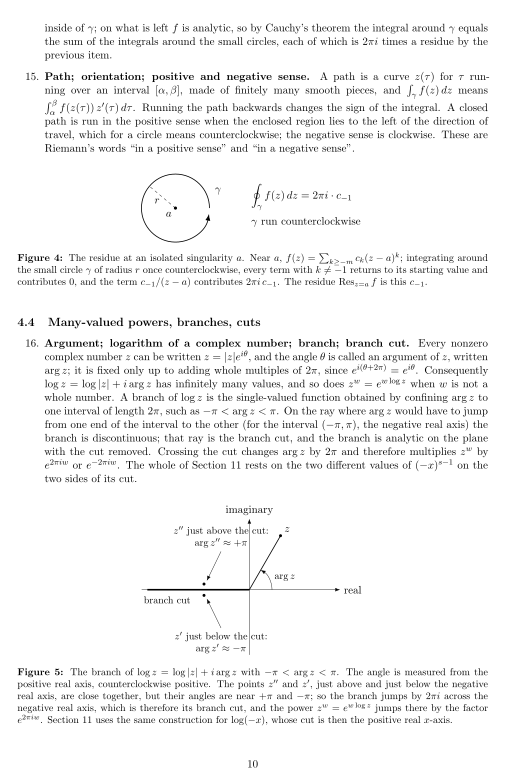
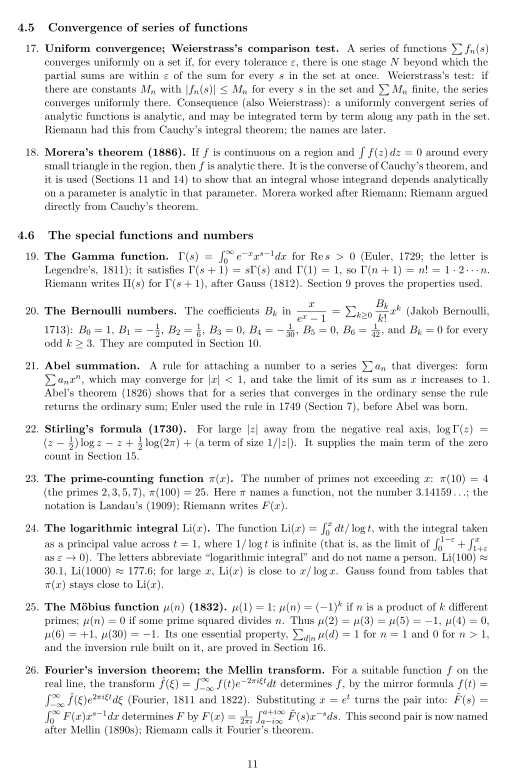
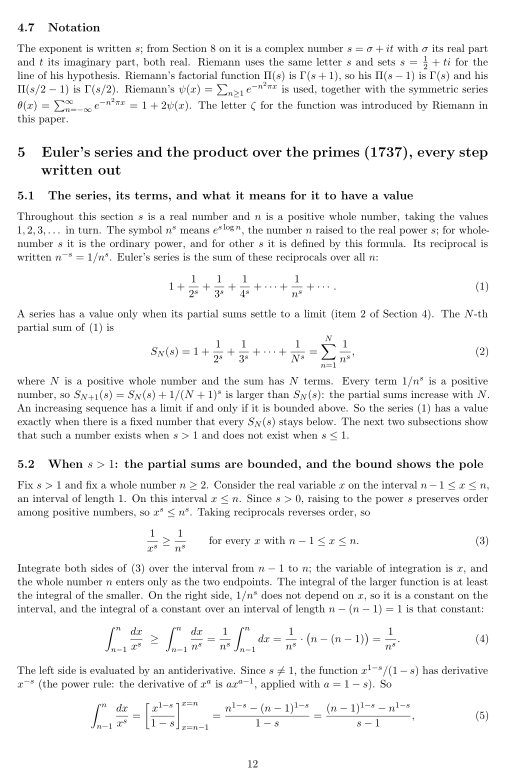
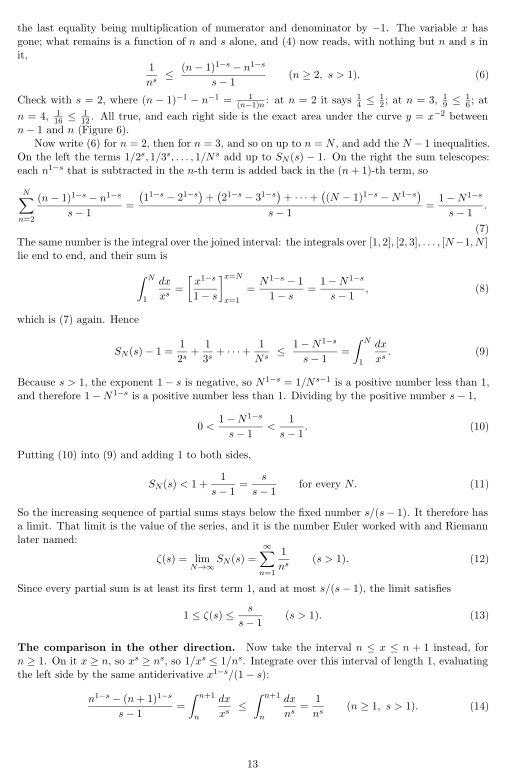
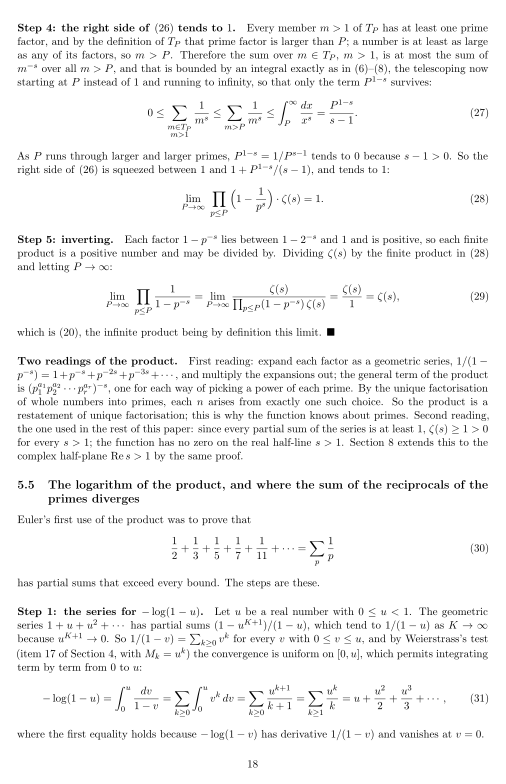
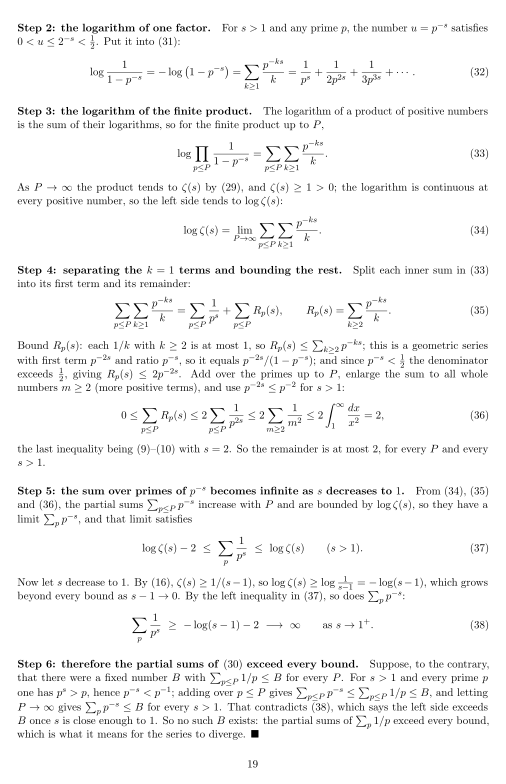
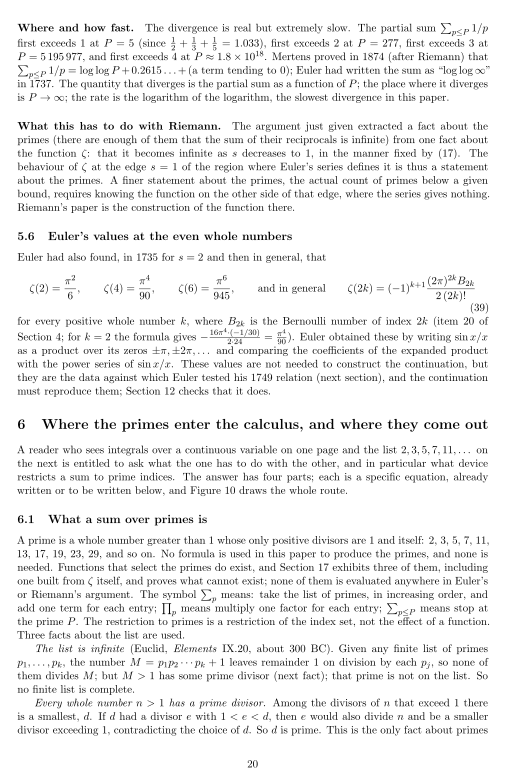
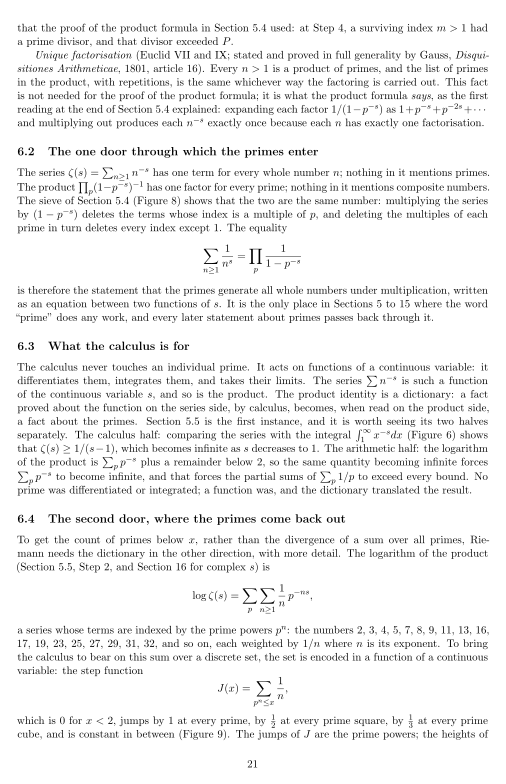
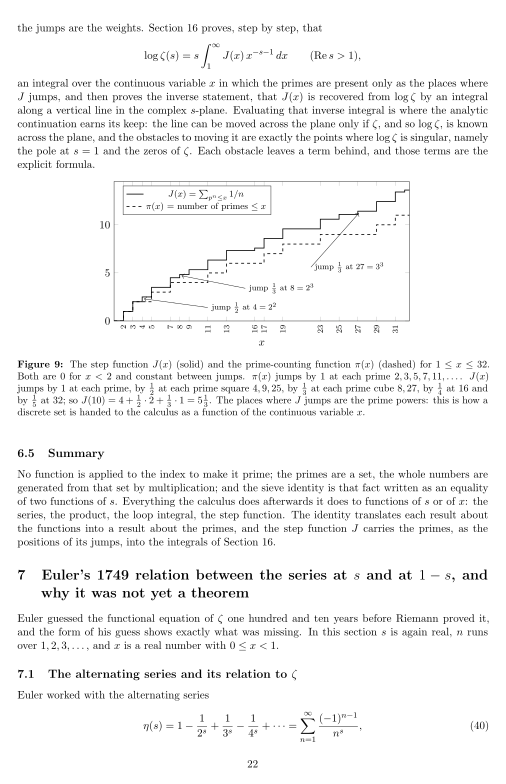
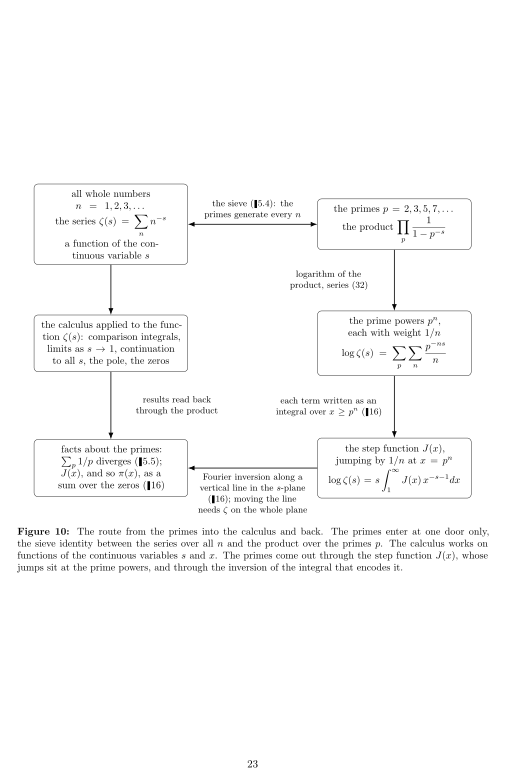
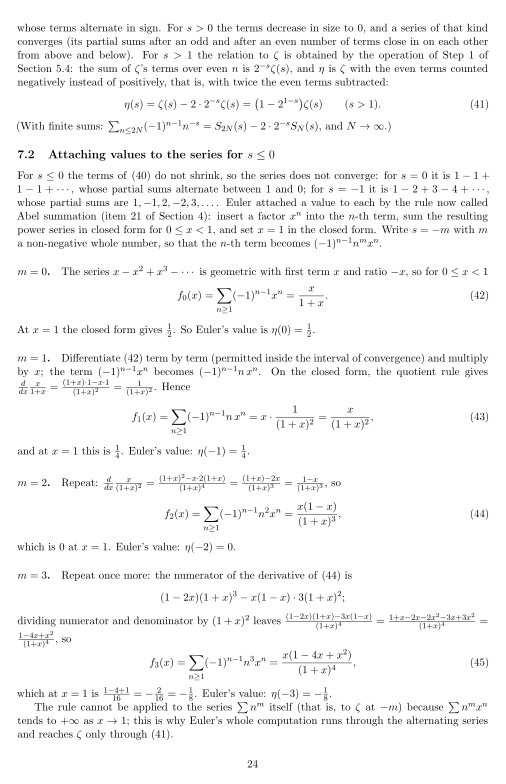
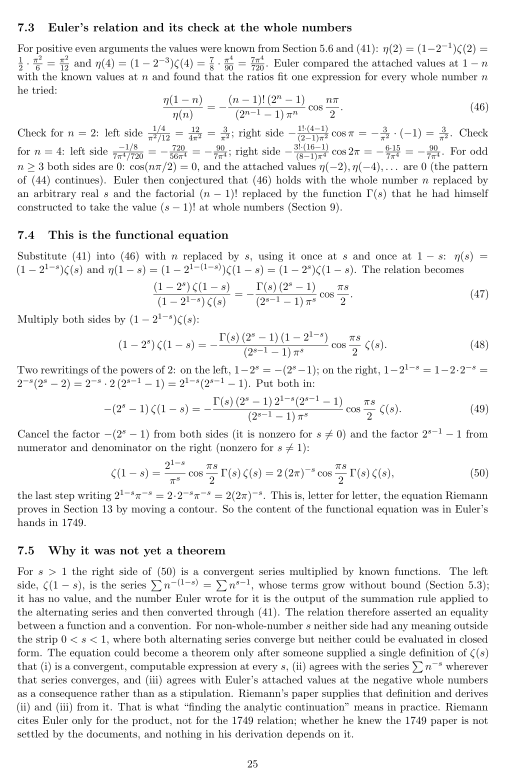
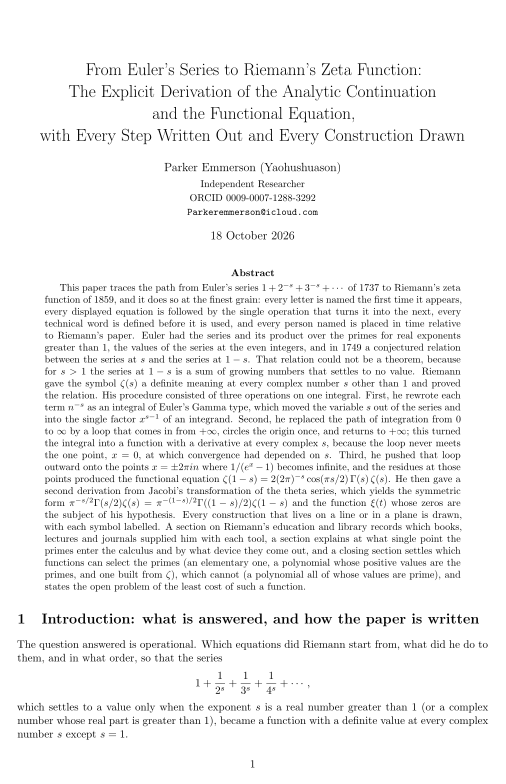
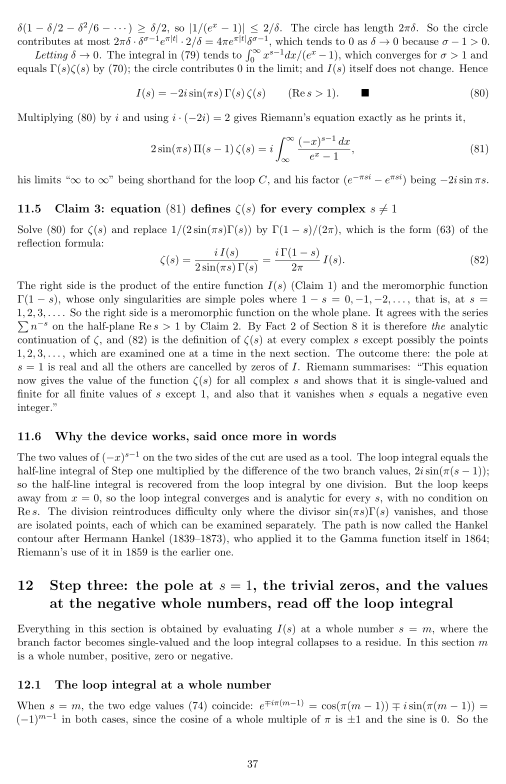
This paper traces the path from Euler’s series 1 + 2−s + 3−s + ··· of 1737 to Riemann’s zeta function of 1859, and it does so at the finest grain: every letter is named the first time it appears, every displayed equation is followed by the single operation that turns it into the next, every technical word is defined before it is used, and every person named is placed in time relative to Riemann’s paper. Euler had the series and its product over the primes for real exponents greater than 1, the values of the series at the even integers, and in 1749 a conjectured relation between the series at s and the series at 1 − s. That relation could not be a theorem, because for s > 1 the series at 1 − s is a sum of growing numbers that settles to no value. Riemann gave the symbol ζ(s) a definite meaning at every complex number s other than 1 and proved the relation. His procedure consisted of three operations on one integral. First, he rewrote each term n−s as an integral of Euler’s Gamma type, which moved the variable s out of the series and into the single factor xs−1 of an integrand. Second, he replaced the path of integration from 0 to ∞ by a loop that comes in from +∞, circles the origin once, and returns to +∞; this turned the integral into a function with a derivative at every complex s, because the loop never meets the one point, x = 0, at which convergence had depended on s. Third, he pushed that loop outward onto the points x = ±2πin where 1/(ex − 1) becomes infinite, and the residues at those points produced the functional equation ζ(1 − s) = 2(2π)−s cos(πs/2) Γ(s) ζ(s). He then gave a second derivation from Jacobi’s transformation of the theta series, which yields the symmetric form π−s/2 Γ(s/2) ζ(s) = π−(1−s)/2 Γ((1 − s)/2) ζ(1 − s) and the function ξ(t) whose zeros are the subject of his hypothesis. Every construction that lives on a line or in a plane is drawn, with each symbol labelled. A section on Riemann’s education and library records which books, lectures and journals supplied him with each tool, a section explains at what single point the primes enter the calculus and by what device they come out, and a closing section settles which functions can select the primes (an elementary one, a polynomial whose positive values are the primes, and one built from ζ), which cannot (a polynomial all of whose values are prime), and states the open problem of the least cost of such a function.

Contents

  1. 1. Introduction: what is answered, and how the paper is written p. 1
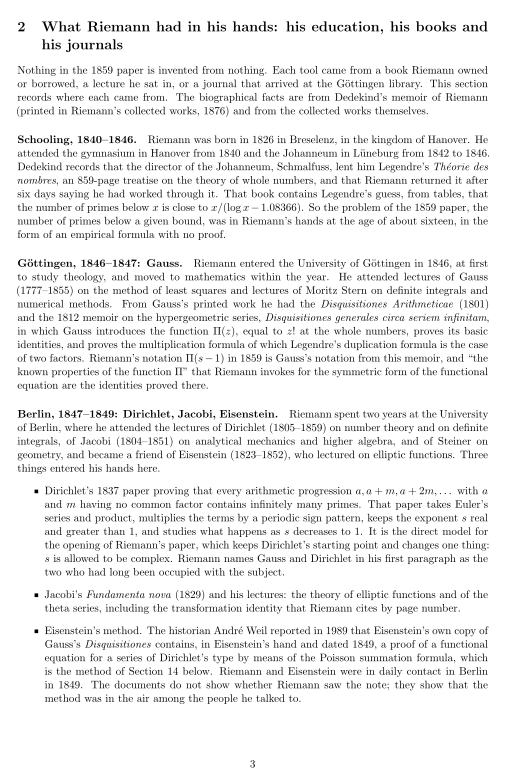
    1. 2. What Riemann had in his hands: his education, his books and his journals p. 3
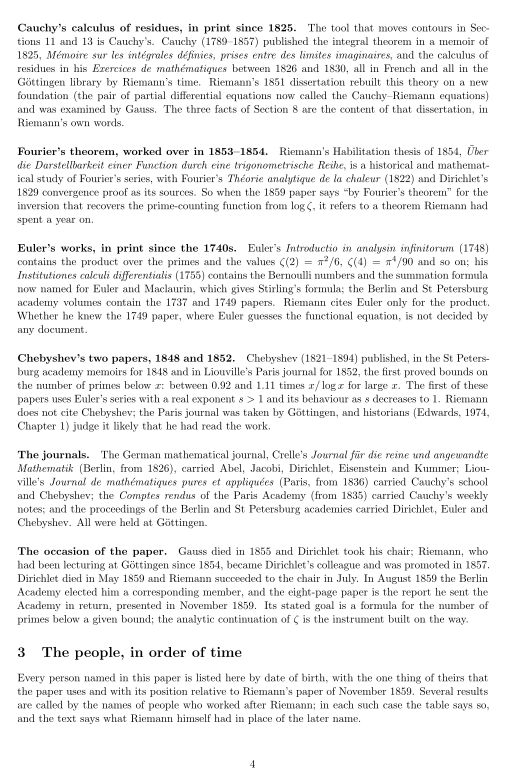
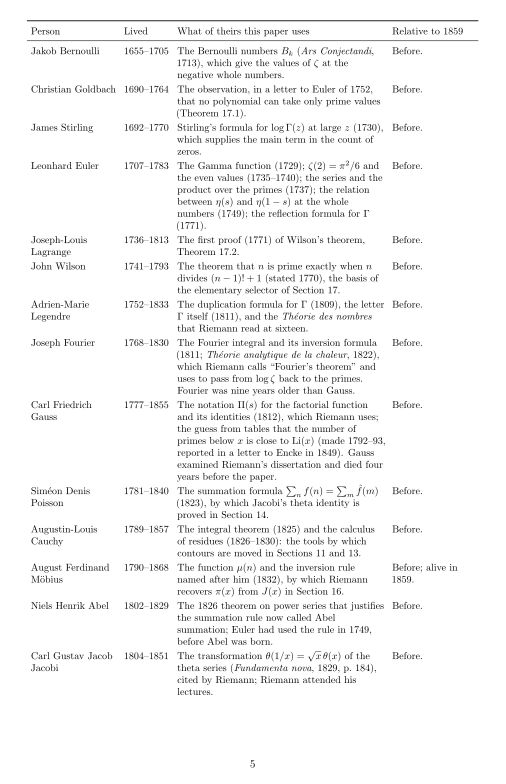
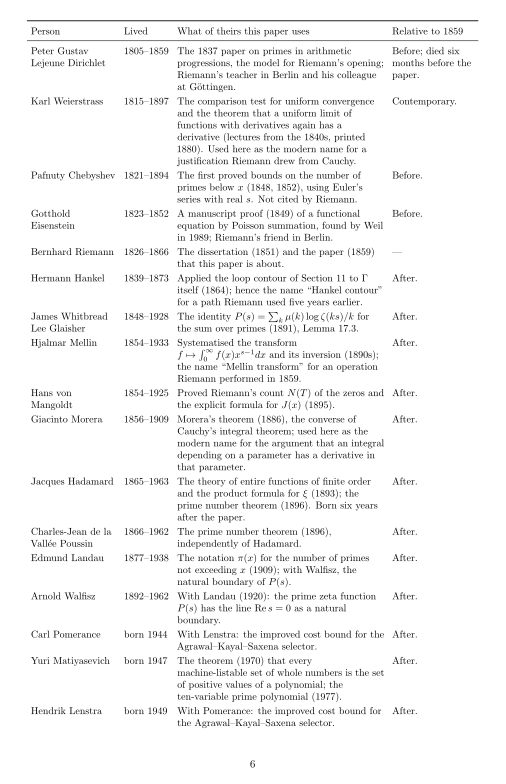
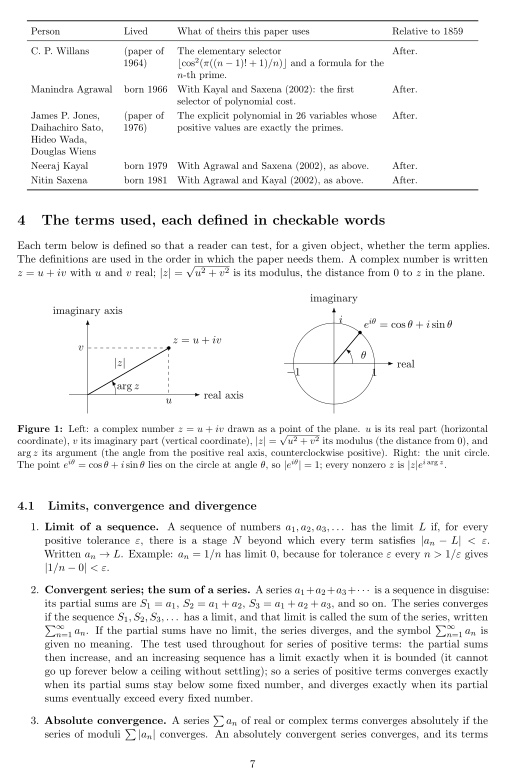
      1. 3. The people, in order of time p. 4
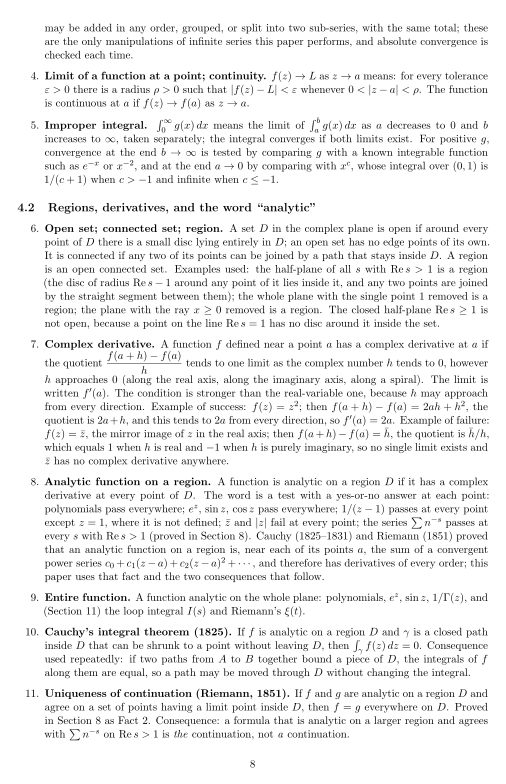
        1. 4. The terms used, each defined in checkable words p. 7
          1. Limits, convergence and divergence p. 7
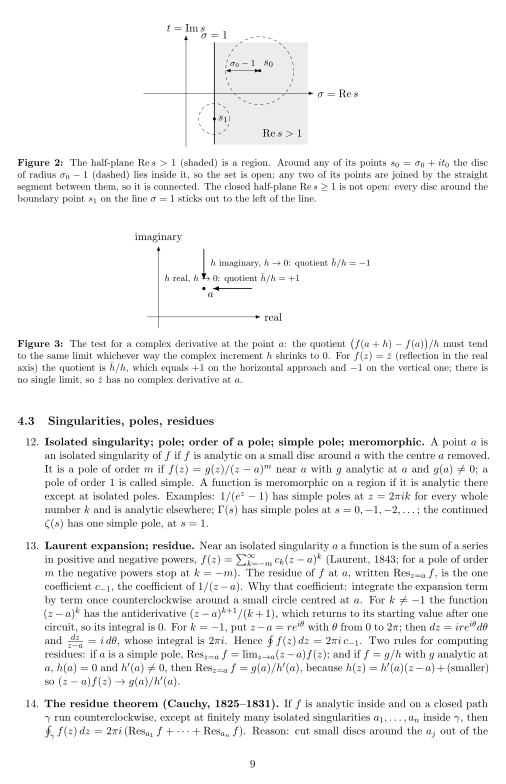
          2. Regions, derivatives, and the word “analytic” p. 8
          3. Singularities, poles, residues p. 9
          4. Many-valued powers, branches, cuts p. 10
          5. Convergence of series of functions p. 11
          6. The special functions and numbers p. 11
          7. Notation p. 12
        2. 5. Euler's series and the product over the primes (1737), every step written out p. 12
          1. The series, its terms, and what it means for it to have a value p. 12
          2. When s>1: the partial sums are bounded, and the bound shows the pole p. 12
          3. When s<=1: the partial sums exceed every bound, so the series has no value p. 14
          4. The product over the primes, proved with finite sums p. 16
          5. The logarithm of the product, and where the sum of the reciprocals of the primes diverges p. 18
          6. Euler's values at the even whole numbers p. 20
        3. 6. Where the primes enter the calculus, and where they come out p. 20
          1. What a sum over primes is p. 20
          2. The one door through which the primes enter p. 21
          3. What the calculus is for p. 21
          4. The second door, where the primes come back out p. 21
          5. Summary p. 22
        4. 7. Euler's 1749 relation between the series at s and at 1-s, and why it was not yet a theorem p. 22
          1. The alternating series and its relation to zeta p. 22
          2. Attaching values to the series for s<=0 p. 24
          3. Euler's relation and its check at the whole numbers p. 25
          4. This is the functional equation p. 25
          5. Why it was not yet a theorem p. 25
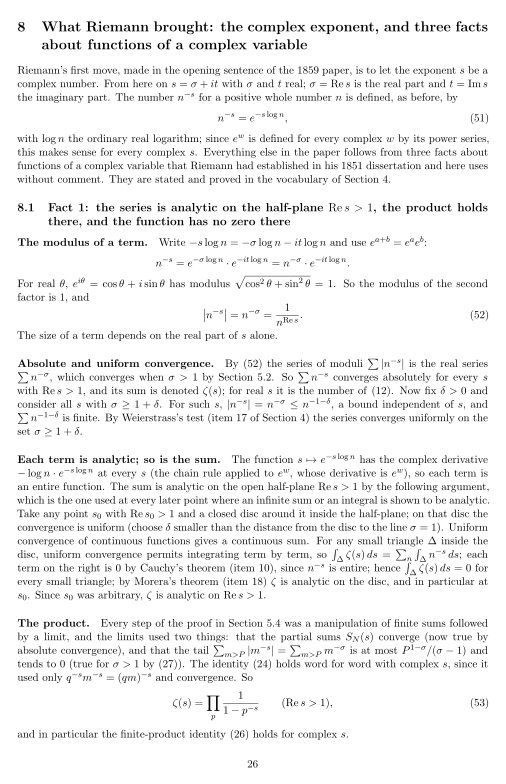
        5. 8. What Riemann brought: the complex exponent, and three facts about functions of a complex variable p. 26
          1. Fact 1: the series is analytic on the half-plane Re s>1, the product holds there, and the function has no zero there p. 26
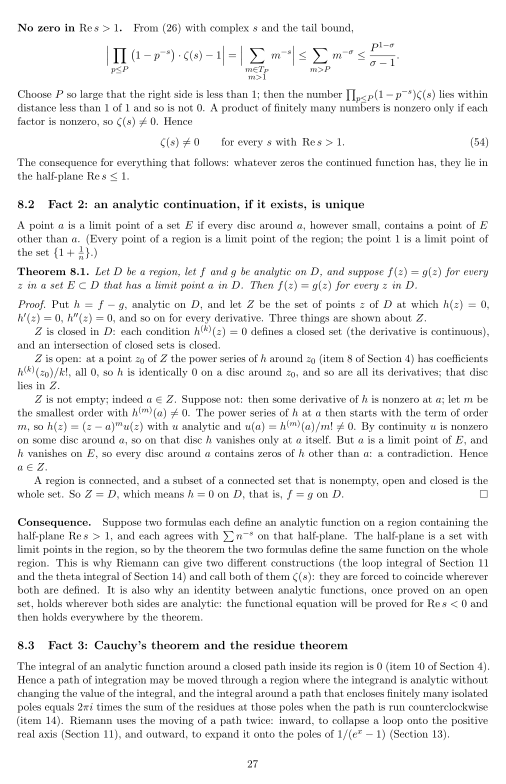
          2. Fact 2: an analytic continuation, if it exists, is unique p. 27
          3. Fact 3: Cauchy's theorem and the residue theorem p. 27
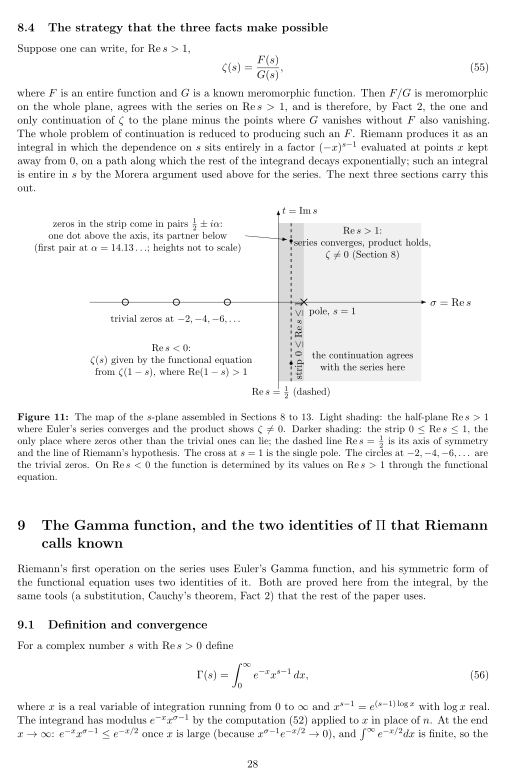
          4. The strategy that the three facts make possible p. 28
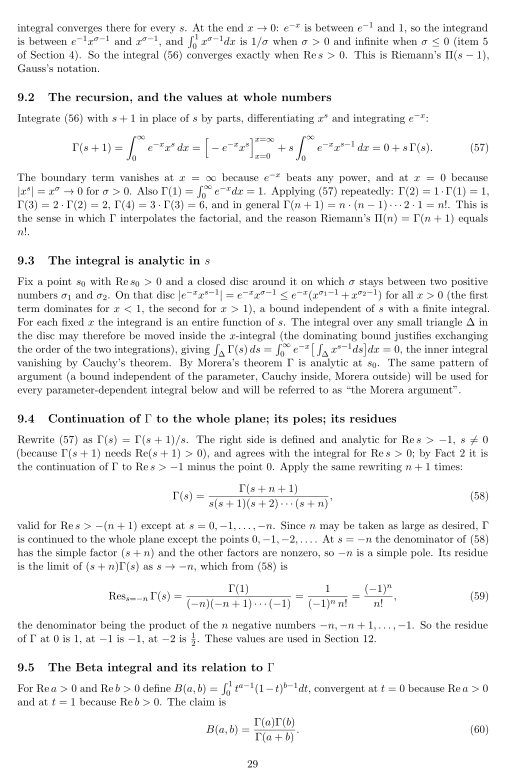
        6. 9. The Gamma function, and the two identities of Pi that Riemann calls known p. 28
          1. Definition and convergence p. 28
          2. The recursion, and the values at whole numbers p. 29
          3. The integral is analytic in s p. 29
          4. Continuation of Gamma to the whole plane; its poles; its residues p. 29
          5. The Beta integral and its relation to Gamma p. 29
          6. Euler's reflection formula, proved by a loop integral p. 30
          7. Legendre's duplication formula, proved by the Beta integral p. 31
        7. 10. Step one: the Gamma integral replaces the series p. 32
          1. One term of the series as an integral p. 32
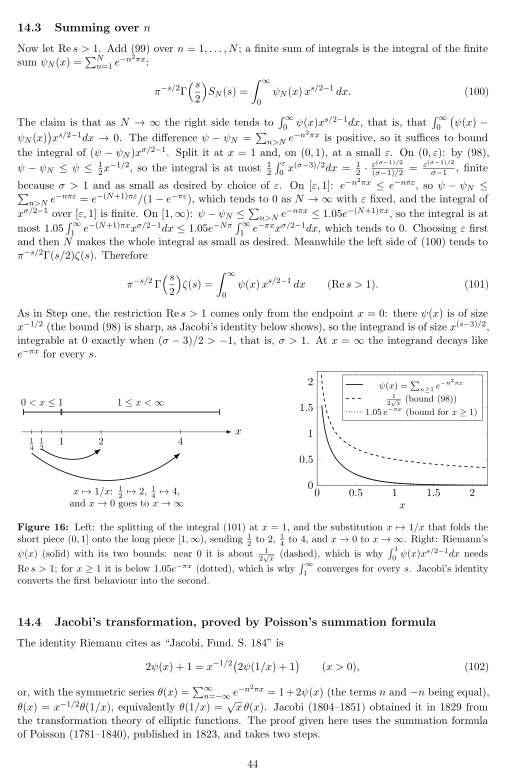
          2. Summing over n p. 32
          3. Two facts about 1/(e^x-1) for later use p. 33
        8. 11. Step two: the loop integral around the origin gives the continuation to the whole plane p. 34
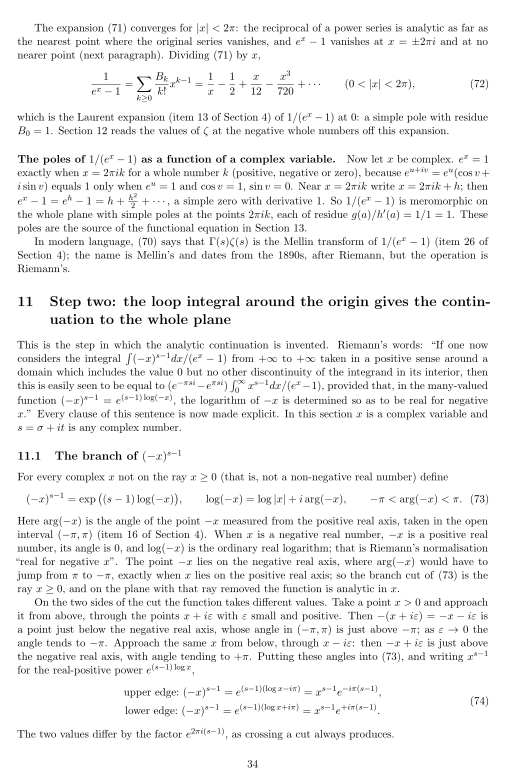
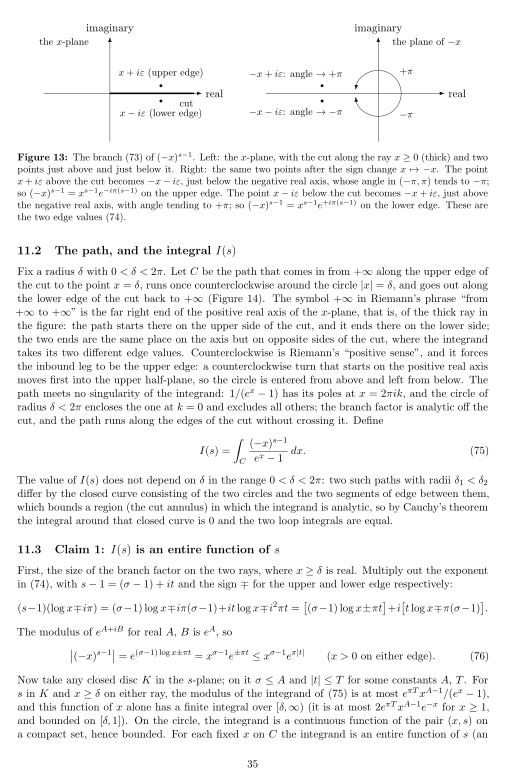
          1. The branch of (-x)^(s-1) p. 34
          2. The path, and the integral I(s) p. 35
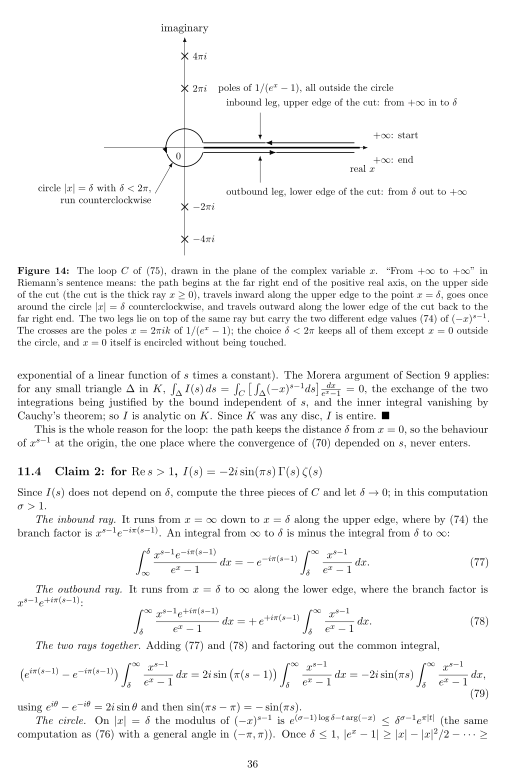
          3. Claim 1: I(s) is an entire function of s p. 35
          4. Claim 2: for Re s>1, I(s) = -2i sin(pi s) Gamma(s) zeta(s) p. 36
          5. Claim 3: equation (81) defines zeta(s) for every complex s not 1 p. 37
          6. Why the device works, said once more in words p. 37
        9. 12. Step three: the pole at s=1, the trivial zeros, and the values at the negative whole numbers, read off the loop integral p. 37
          1. The loop integral at a whole number p. 37
          2. The whole numbers m>=2: no pole, and the value of the series is recovered p. 38
          3. The point s=1: a simple pole with residue exactly 1 p. 38
          4. The negative whole numbers: the values Euler attached to divergent series p. 38
          5. The trivial zeros p. 39
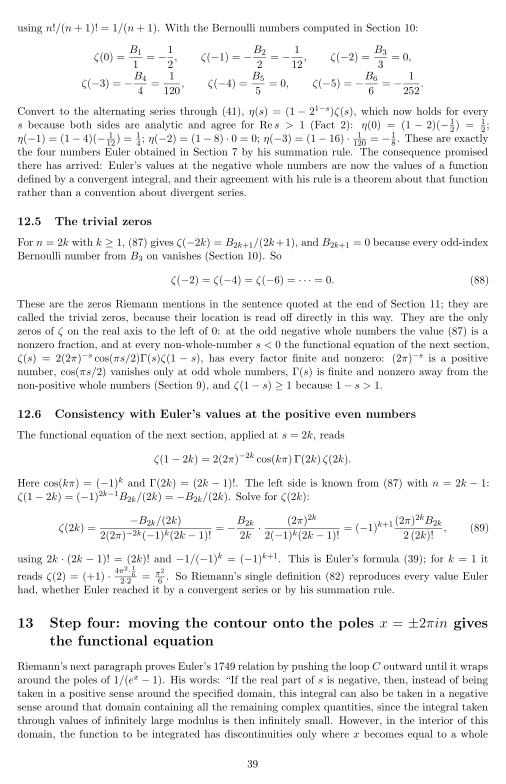
          6. Consistency with Euler's values at the positive even numbers p. 39
        10. 13. Step four: moving the contour onto the poles x = +-2 pi i n gives the functional equation p. 39
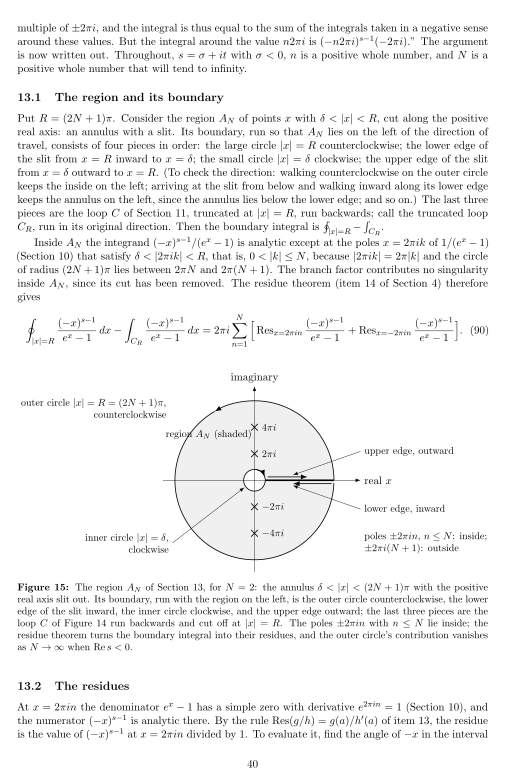
          1. The region and its boundary p. 40
          2. The residues p. 40
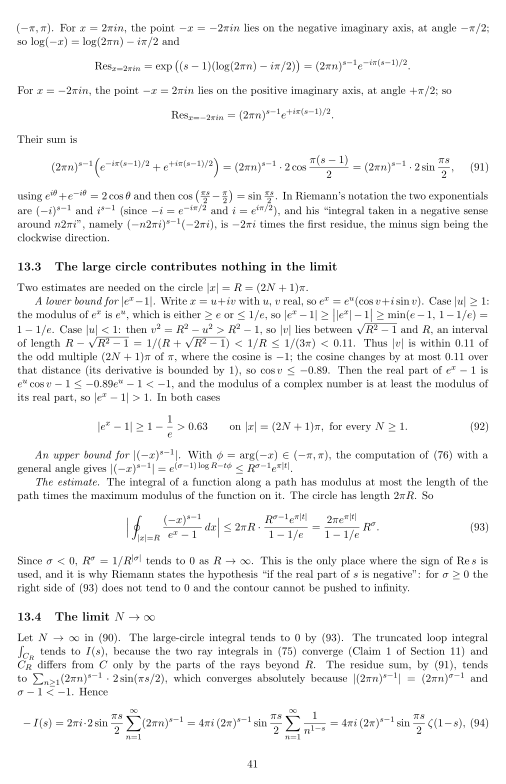
          3. The large circle contributes nothing in the limit p. 41
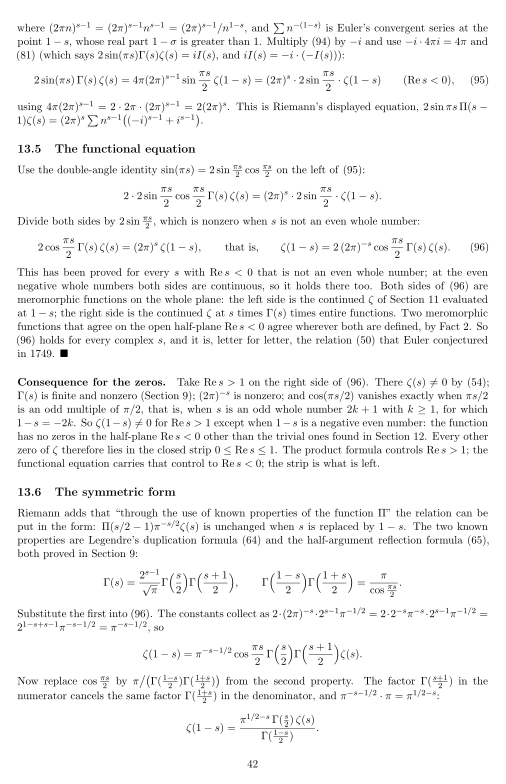
          4. The limit N to infinity p. 41
          5. The functional equation p. 42
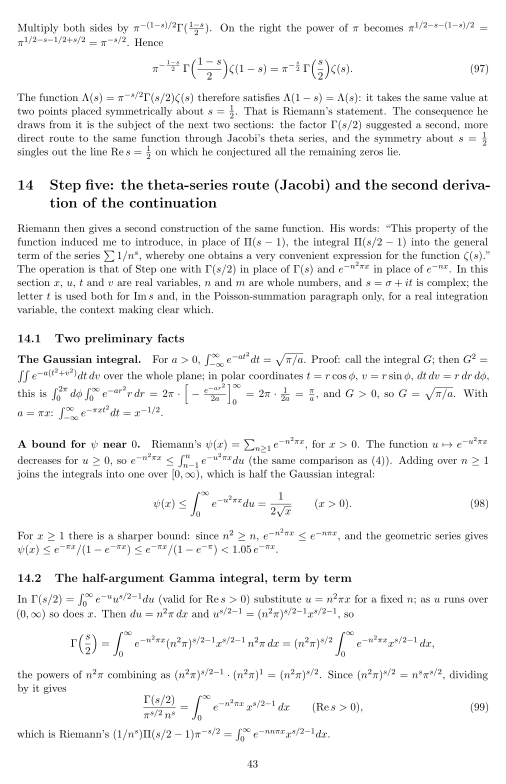
          6. The symmetric form p. 42
        11. 14. Step five: the theta-series route (Jacobi) and the second derivation of the continuation p. 43
          1. Two preliminary facts p. 43
          2. The half-argument Gamma integral, term by term p. 43
          3. Summing over n p. 44
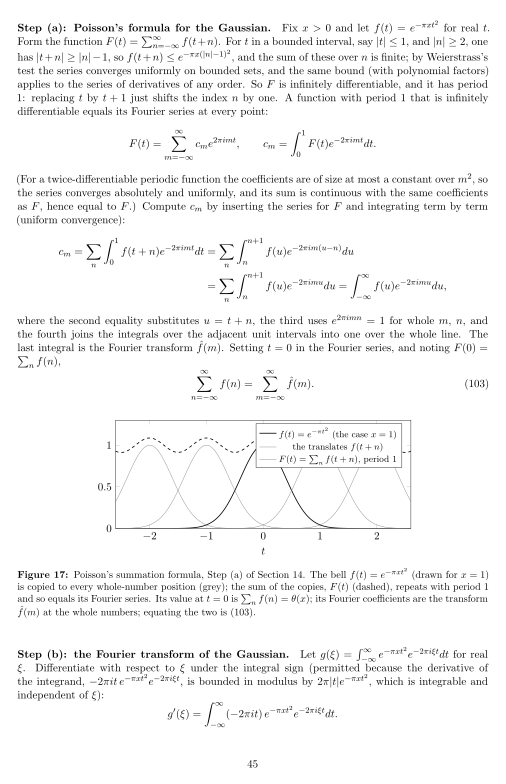
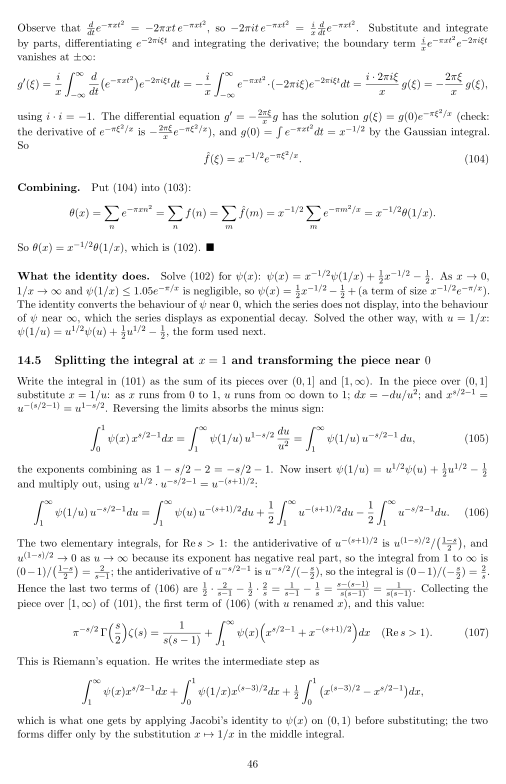
          4. Jacobi's transformation, proved by Poisson's summation formula p. 44
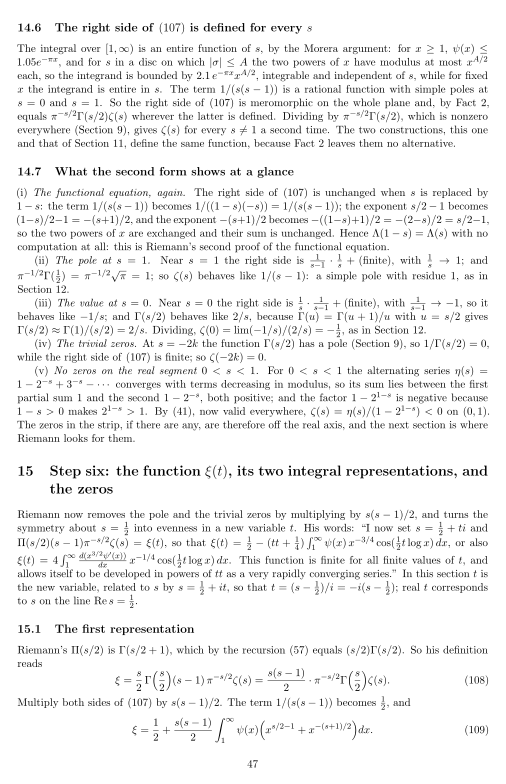
          5. Splitting the integral at x=1 and transforming the piece near 0 p. 46
          6. The right side of (107) is defined for every s p. 47
          7. What the second form shows at a glance p. 47
        12. 15. Step six: the function xi(t), its two integral representations, and the zeros p. 47
          1. The first representation p. 47
          2. Which zeros xi has p. 48
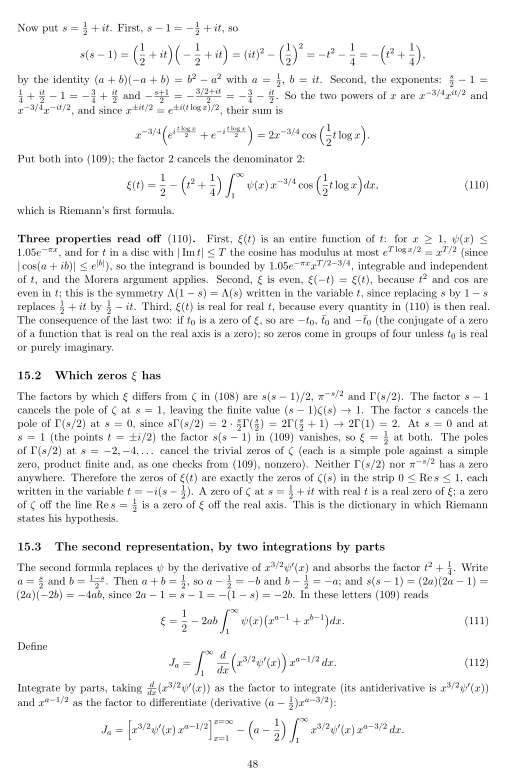
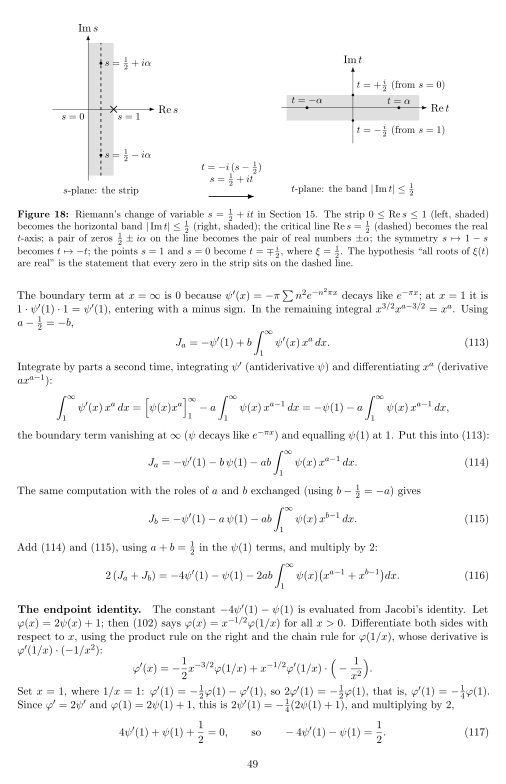
          3. The second representation, by two integrations by parts p. 48
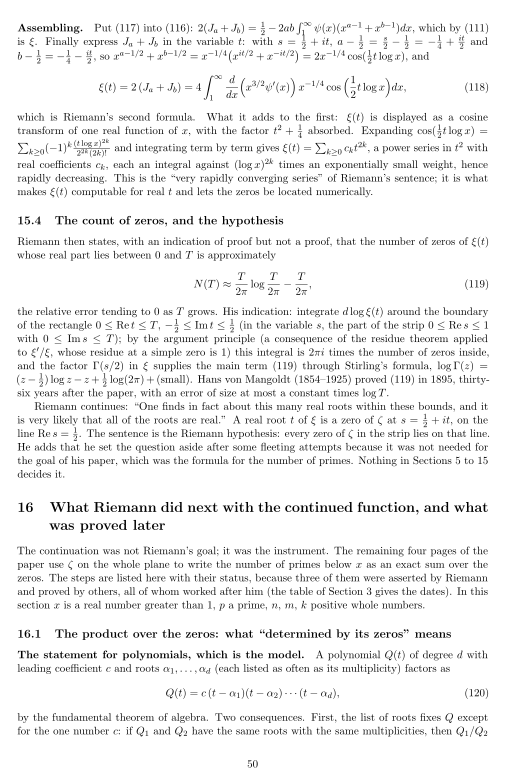
          4. The count of zeros, and the hypothesis p. 50
        13. 16. What Riemann did next with the continued function, and what was proved later p. 50
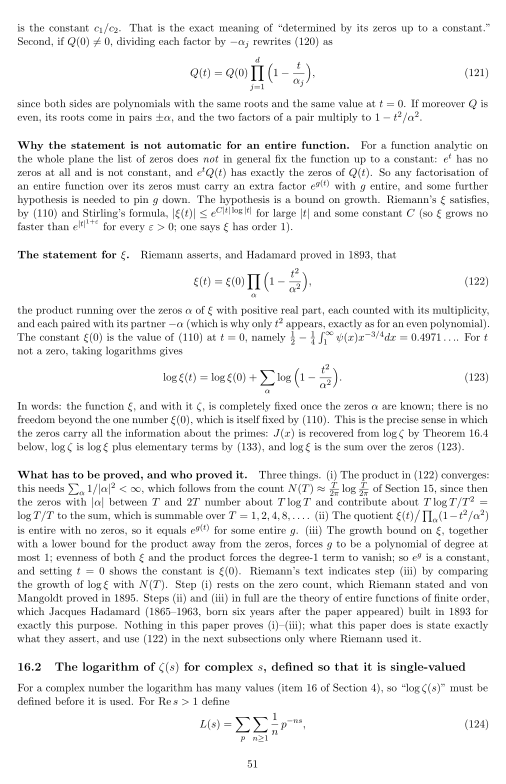
          1. The product over the zeros: what “determined by its zeros” means p. 50
          2. The logarithm of zeta(s) for complex s, defined so that it is single-valued p. 51
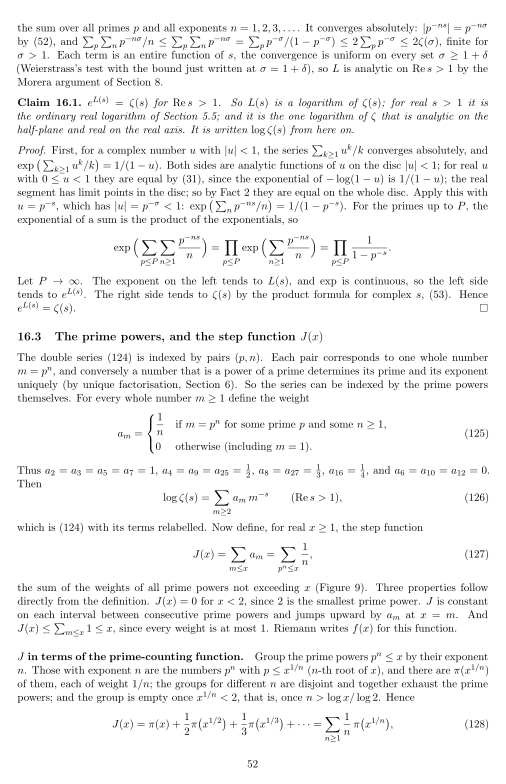
          3. The prime powers, and the step function J(x) p. 52
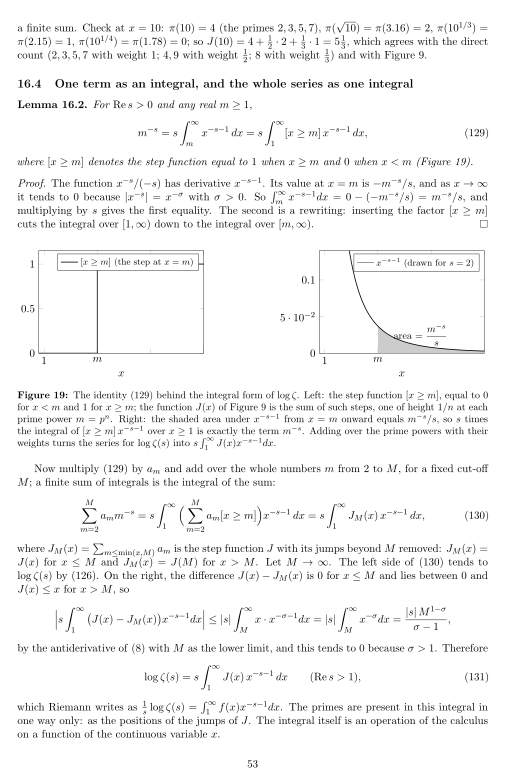
          4. One term as an integral, and the whole series as one integral p. 53
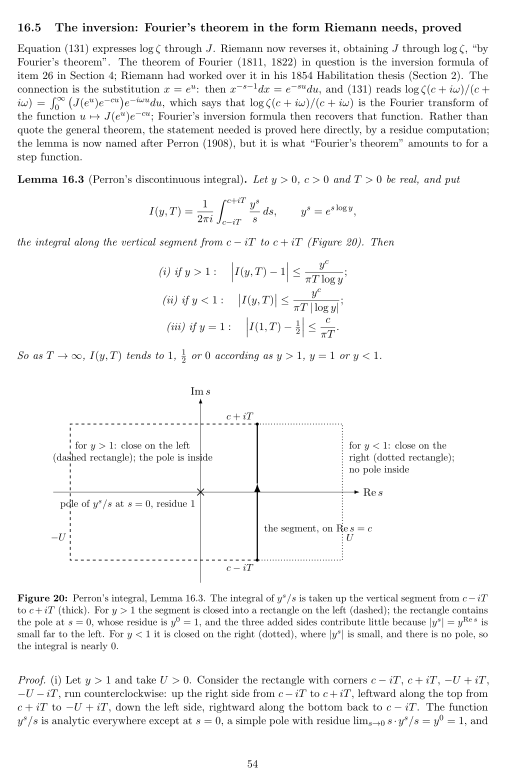
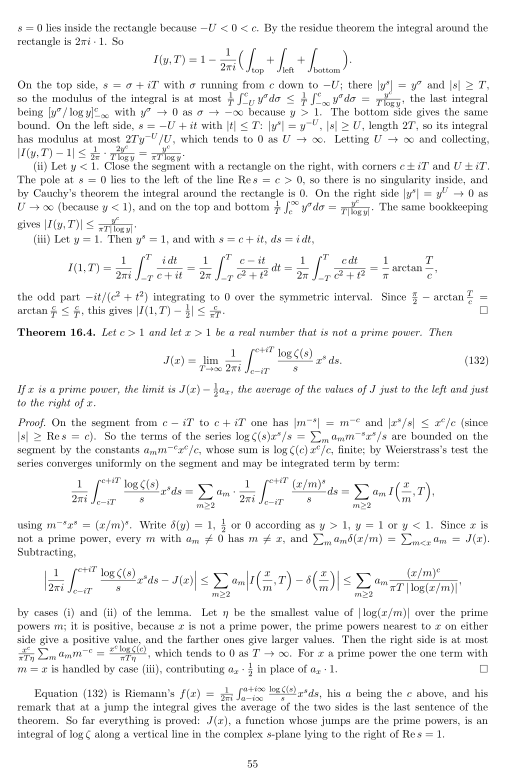
          5. The inversion: Fourier's theorem in the form Riemann needs, proved p. 54
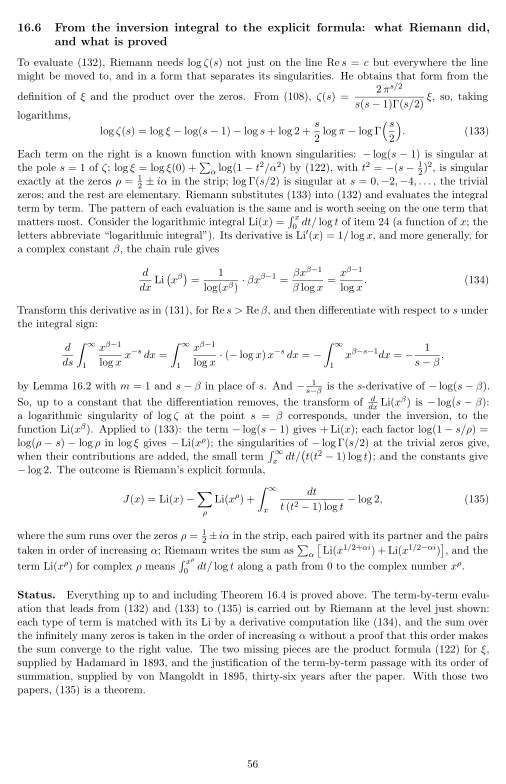
          6. From the inversion integral to the explicit formula: what Riemann did, and what is proved p. 56
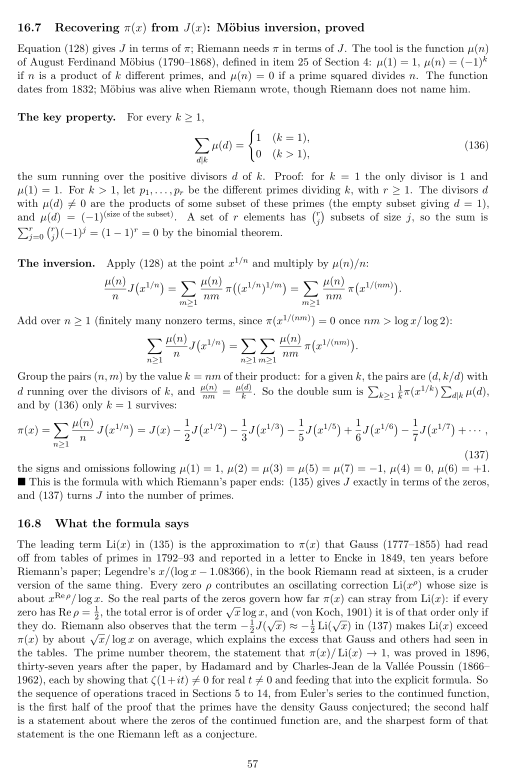
          7. Recovering pi(x) from J(x): Möbius inversion, proved p. 57
          8. What the formula says p. 57
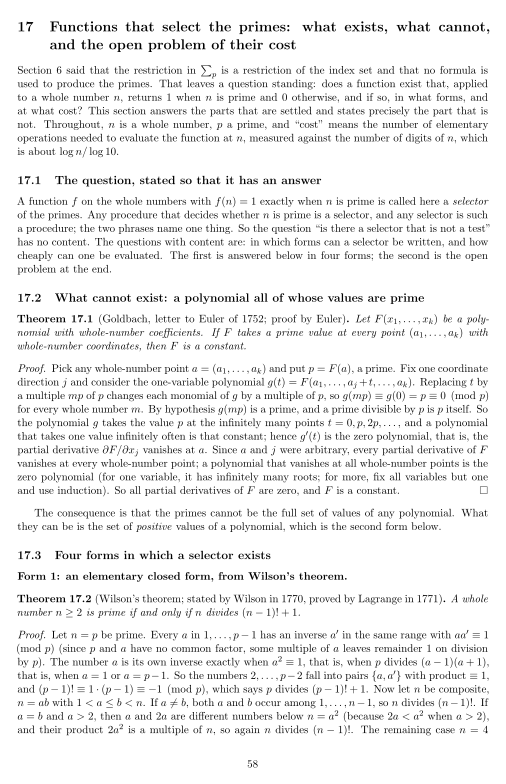
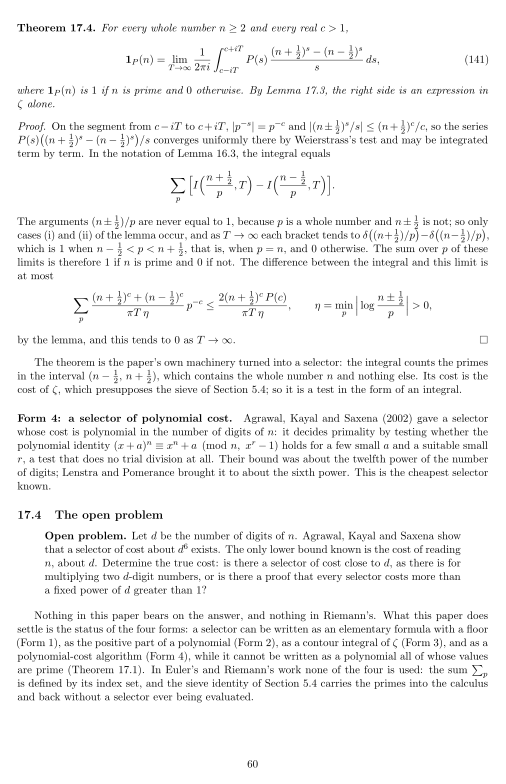
        14. 17. Functions that select the primes: what exists, what cannot, and the open problem of their cost p. 58
          1. The question, stated so that it has an answer p. 58
          2. What cannot exist: a polynomial all of whose values are prime p. 58
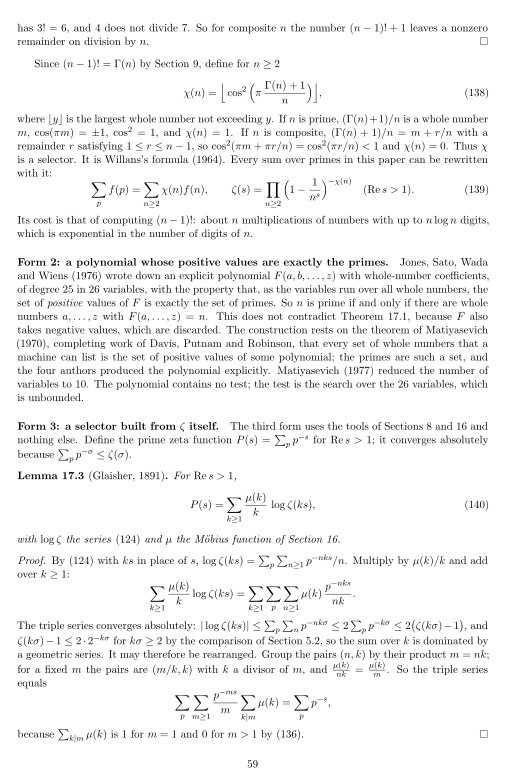
          3. Four forms in which a selector exists p. 58
          4. The open problem p. 60
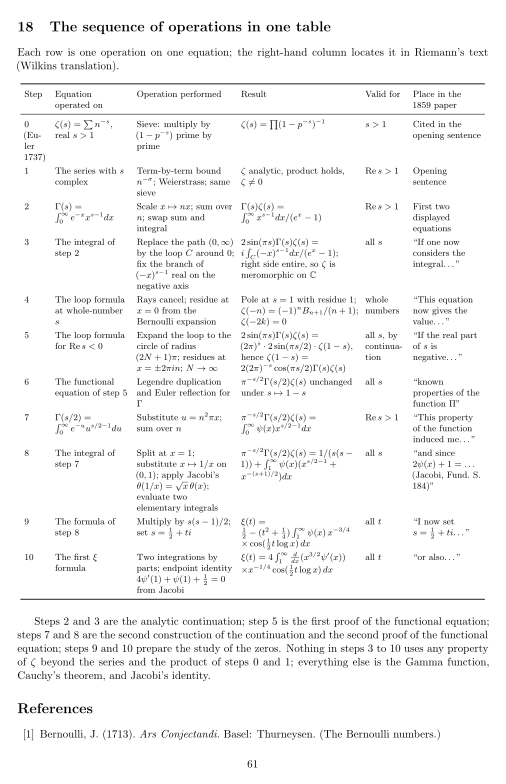
        15. 18. The sequence of operations in one table p. 61
          Page 1 of the paper
          page 1 of 64
          Page 2 of the paper
          page 2 of 64
          Page 3 of the paper
          page 3 of 64
          Page 4 of the paper
          page 4 of 64
          Page 5 of the paper
          page 5 of 64
          Page 6 of the paper
          page 6 of 64
          Page 7 of the paper
          page 7 of 64
          Page 8 of the paper
          page 8 of 64
          Page 9 of the paper
          page 9 of 64
          Page 10 of the paper
          page 10 of 64
          Page 11 of the paper
          page 11 of 64
          Page 12 of the paper
          page 12 of 64
          Page 13 of the paper
          page 13 of 64
          Page 14 of the paper
          page 14 of 64
          Page 15 of the paper
          page 15 of 64
          Page 16 of the paper
          page 16 of 64
          Page 17 of the paper
          page 17 of 64
          Page 18 of the paper
          page 18 of 64
          Page 19 of the paper
          page 19 of 64
          Page 20 of the paper
          page 20 of 64
          Page 21 of the paper
          page 21 of 64
          Page 22 of the paper
          page 22 of 64
          Page 23 of the paper
          page 23 of 64
          Page 24 of the paper
          page 24 of 64
          Page 25 of the paper
          page 25 of 64
          Page 26 of the paper
          page 26 of 64
          Page 27 of the paper
          page 27 of 64
          Page 28 of the paper
          page 28 of 64
          Page 29 of the paper
          page 29 of 64
          Page 30 of the paper
          page 30 of 64
          Page 31 of the paper
          page 31 of 64
          Page 32 of the paper
          page 32 of 64
          Page 33 of the paper
          page 33 of 64
          Page 34 of the paper
          page 34 of 64
          Page 35 of the paper
          page 35 of 64
          Page 36 of the paper
          page 36 of 64
          Page 37 of the paper
          page 37 of 64
          Page 38 of the paper
          page 38 of 64
          Page 39 of the paper
          page 39 of 64
          Page 40 of the paper
          page 40 of 64
          Page 41 of the paper
          page 41 of 64
          Page 42 of the paper
          page 42 of 64
          Page 43 of the paper
          page 43 of 64
          Page 44 of the paper
          page 44 of 64
          Page 45 of the paper
          page 45 of 64
          Page 46 of the paper
          page 46 of 64
          Page 47 of the paper
          page 47 of 64
          Page 48 of the paper
          page 48 of 64
          Page 49 of the paper
          page 49 of 64
          Page 50 of the paper
          page 50 of 64
          Page 51 of the paper
          page 51 of 64
          Page 52 of the paper
          page 52 of 64
          Page 53 of the paper
          page 53 of 64
          Page 54 of the paper
          page 54 of 64
          Page 55 of the paper
          page 55 of 64
          Page 56 of the paper
          page 56 of 64
          Page 57 of the paper
          page 57 of 64
          Page 58 of the paper
          page 58 of 64
          Page 59 of the paper
          page 59 of 64
          Page 60 of the paper
          page 60 of 64
          Page 61 of the paper
          page 61 of 64
          Page 62 of the paper
          page 62 of 64
          Page 63 of the paper
          page 63 of 64
          Page 64 of the paper
          page 64 of 64